
Why the Average Cold Email Gets a 3.43% Reply Rate (and What Actually Gets You to 10%)


A founder sending outreach after hours, the only quiet stretch in the day. Photo: Pexels.
You sent 220 cold emails this week. You got 5 replies, and two of them were no thanks.
If you are running growth at a small B2B company and doing the outreach yourself, usually late, usually after the standup and the sales calls and dinner, that result stings more than it should.
Here is what takes some of the sting out of that.
The average cold email reply rate in 2026 is 3.43%, based on Instantly’s 2026 benchmark report, which analyzed billions of sends across thousands of workspaces through the end of 2025.
So on 220 emails, the statistical average is about 7 or 8 replies. You are not far off the average.
Average is just low right now.
This piece is about why it got this low, and what the people clearing 10% are actually doing differently.
If you would rather hand the whole thing off, that is what my cold email service is for. But every fix in this piece is one you can run yourself, and I am going to show you how.
Table of Contents
What Counts as a Good Cold Email Reply Rate in 2026?
A good cold email reply rate in 2026 is 5% or higher. The overall average is 3.43%. The top quartile of campaigns clears 5.5%, and the top 10%, what Instantly calls “elite” senders, sit at 10.7% or better.
Anything under about 2% means something upstream is broken, usually targeting or deliverability, not the words in the email.
Some tools call this the cold email response rate instead of the reply rate. It is the same metric and the same 3.43% baseline.
That spread matters more than the average. Two founders can send the same number of emails and see a 5x difference in replies, and it is almost never because one of them is a better writer.
| Tier | Reply rate | What it usually means |
| Bottom | Under 2% | List or deliverability problem, not a copy problem |
| Average | 3.43% | Real targeting, generic execution |
| Top quartile | 5.5% or more | Tight list, some real personalization, a follow-up or two |
| Elite (top 10%) | 10.7% or more | Small lists, deep personalization, structured sequence, short emails |
Reply rates have been sliding for years.
Cleverly’s 2026 analysis of more than 100 million cold emails puts the average cold email reply rate at 8.5% back in 2019, falling to today’s 3.43%.
The channel is not dead. It is just more crowded, and the bar for a reply is higher.
The Number That Actually Matters Is Further Down the Funnel
A raw reply rate includes “unsubscribe” and “stop emailing me.” The metrics that pay rent are the positive reply rate and the meeting rate, and they need their own benchmarks.
Per 2026 figures from Apollo and Belkins, a positive reply rate of 0.5% to 2% is normal and 5% is exceptional. A meeting booked rate of 3% to 4% is good, and 5% or higher is excellent.
| Metric | Normal | Strong |
| Total reply rate | 3% to 4% | 8% or more |
| Positive reply rate | 0.5% to 2% | 5% or more |
| Meeting booked rate | 3% to 4% | 5% or more |
If you are tracking only total replies, you are flying with one instrument. Track all three from the start.

The average professional now sees well over a hundred emails a day. Photo: Pexels.
Why Your Reply Rate Is Probably Below Average, and It Is Usually Not the Copy
Most founders assume a weak reply rate means the email was bad. Usually the email was fine and it was never actually read.
Three things happened to the inbox between 2023 and now. The average B2B buyer receives 3 to 5 times more cold email than they did in 2023, and most of it is written by AI. Professionals in buying roles now sort past 120 or more emails a day. And Google, Yahoo, and Microsoft tightened their bulk sender rules across 2024 and 2025, so filters are far more aggressive than they were.
The result is a delivery problem before it is a persuasion problem. A 2026 deliverability analysis from icemail found that roughly 1 in 5 cold emails never reaches the inbox at all, landing in spam or getting blocked on the way in.
Deliverability Is the Tax You Pay Before Copy Even Matters
You cannot write your way out of the spam folder. Before a single word does any work, the mechanical stuff has to be right.
Keep your spam complaint rate under 0.1%, the line Gmail and Outlook now enforce for anyone sending at volume. Keep your bounce rate under 2%.
Instantly’s data shows teams that hold their domain health steady see 15% to 20% higher replies just from that, with nothing changed in the message.
| Stage | Rough pass rate | Where founders lose it |
| Sent to delivered | About 83% | Weak domain setup, no warmup, high bounce list |
| Delivered to opened | 25% to 35% | Vague or spammy subject line, unknown sender name |
| Opened to replied | 8% to 15% | Generic body, no clear ask, too long |
Each stage multiplies. A 10 point drop at the top quietly halves what comes out the bottom.
The channel only works if the sending setup behind it is right. Photo: Pexels.
The Four Things That Move a Reply Rate From 3% to 10%
Four levers separate a 3% campaign from a 10% one. In order of impact: list size, personalization depth, the follow-up sequence, and email length.
1. Smaller Lists Beat Bigger Ones, by a Lot
Cutting your list is the single fastest way to raise your reply rate. Cleverly’s 2026 data shows campaigns sent to fewer than 50 recipients average a 5.8% reply rate, against 2.1% for large sends.
Belkins found the same shape in its own numbers, with roughly 50 recipient campaigns pulling 2.8 times the response rate of 500 plus recipient blasts.
The math is uncomfortable but freeing. 100 emails you actually researched will beat 1,000 you merged from a spreadsheet, on replies and on meetings booked.
For a founder with no time, that is the good news. The version that works is also the smaller one.

A list you can actually research one name at a time. Photo: Pexels.
2. Personalization Is a Spectrum, Not a Merge Tag
“Hi {{first_name}}, I loved what {{company}} is doing” is not personalization. Buyers have seen that exact line a thousand times, and it now reads as a tell that the rest is automated too.
The 2026 benchmark from CleanList breaks it into tiers. A genuinely generic email pulls under 1%.
A research based opening line, something true about that specific company this quarter, pulls 4% to 8%.
Deep personalization, where the whole email only makes sense sent to that one person, pulls 15% to 18%.
Here is the difference in practice.
Generic: “I wanted to reach out because we help SaaS companies improve their outbound results.”
Specific: “You have 3 RevOps roles open in two months, which usually means outbound is about to get a hard number attached to it.”
The second one takes 4 minutes of research.
It also does not need a clever subject line to survive, because the first sentence earns the read.
This is a writing problem more than a tooling problem, which is why my content and copy work and the cold email work tend to go together.
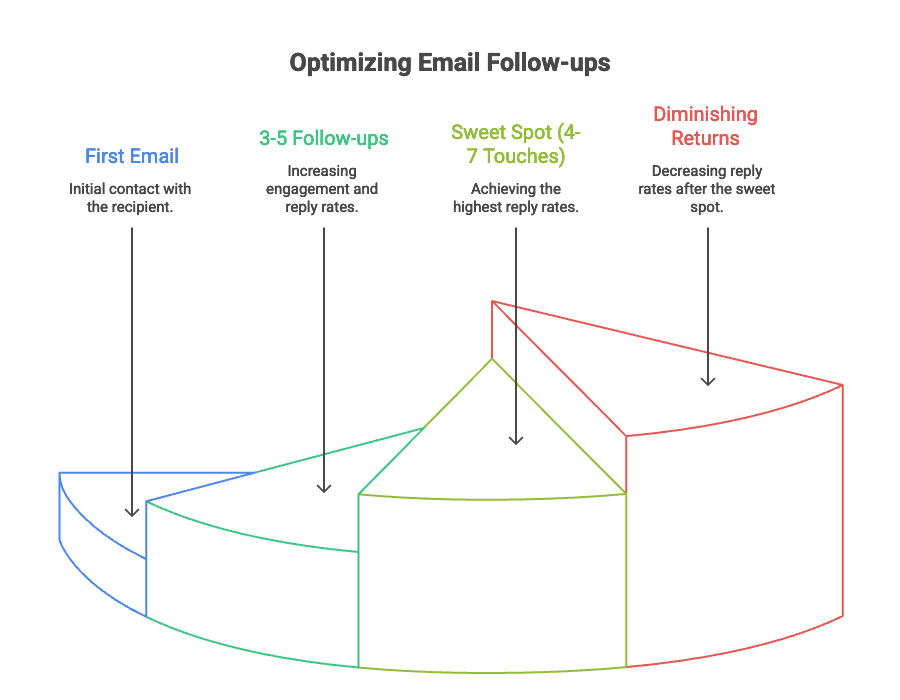
3. The Follow-Ups Are Where Half Your Replies Live
If you send one email and stop, you are leaving close to half your replies on the table. Instantly’s 2026 report attributes 42% of all replies to follow-up steps rather than the first email.
Campaigns with 3 to 5 follow-ups hit an 8.3% reply rate, against 4.1% for sequences with none.
More is not better past a point. Instantly also found reply rates fall by about 55% by the fourth follow-up compared with earlier emails in the sequence.
The sweet spot it identifies is 4 to 7 total touches.
A Follow-Up Sequence That Respects the Reader’s Inbox
Space the touches out, 3 to 4 business days apart, and make each one carry something new. A different angle, a short proof point, a relevant customer story. The goal is to look like a person who keeps thinking about their problem, not a script on a timer.
| Touch | Timing | Job of this email |
| 1 | Day 0 | The research based opener and one clear ask |
| 2 | Day 3 | A different angle on the same problem |
| 3 | Day 7 | One specific proof point or short case |
| 4 | Day 12 | A soft close, easy to say yes or no to |
| 5 to 7 | Optional, spaced wider | New trigger events only, otherwise stop |
The “Just Bumping This to the Top of Your Inbox” Problem
That line, and “circling back,” and “did you see my last email,” add nothing. They ask the reader to do work with no new reason to.
Every touch should give them something they did not have before, or it should not go out.
A sequence planned around the reader’s week, not a timer. Photo: Pexels.
4. Short Emails Win
Long cold emails lose. Overloop’s 2026 analysis of roughly three million sales emails found messages of 50 to 125 words reply at about 8.2%, while emails over 200 words drop to 3.9%. An 80 word email beats a 120 word one by around 15%.
Instantly’s elite senders keep the body under 80 words. That is roughly 4 short sentences: one line of context, one line of relevance, one line of proof, one line with the ask.
| Email length | Approx reply rate | Reads as |
| Under 50 words | Lower, feels templated | A blast |
| 50 to 125 words | 8.2%, the sweet spot | A real person, thought about it |
| Over 200 words | 3.9% | Homework |
What This Looks Like Put Together

Fewer emails, sent with more care, is also the version that fits a full schedule. Photo: Pexels.
If you are the one sending these at 9pm, here is the rebuild, in the order that actually moves the number.
- Fix deliverability first. Proper domain authentication, a warmed sending domain that is not your main one, a verified list with a bounce rate under 2%. Nothing else counts until this is done.
- Cut the list hard. Fewer than 50 highly relevant contacts per campaign to start. You can scale what works later.
- Write one true sentence per prospect. Something real about that company this quarter, in the first line. If you cannot find one, they do not belong on the list yet.
- Keep the email under 80 words. Context, relevance, proof, ask. Cut everything else.
- Build a 4 to 7 touch sequence. Every touch adds something. Space them 3 to 4 days apart. Stop when you run out of real reasons to write.
- Track positive replies and meetings, not just total replies. That is the number your runway actually cares about.
None of this gets you to a 40% reply rate, and anyone promising that is selling something. It gets a careful sender from 3% toward the 8% to 12% range, on fewer emails, which is the entire point when time is the thing you are short on.
If you want a second set of eyes on your current sequence, or you would rather this just get handled while you go back to running the company, email me directly or book a short call here and I will walk you through where your specific numbers are leaking. If you need pipeline faster than cold email can build it, paid ads are the other lever, and you can see the rest of what I do if outbound is only one piece of the problem.
Real Questions About Cold Email Reply Rates, Answered
What is a good cold email reply rate in 2026?
A good cold email reply rate in 2026 is 5% or higher. The overall average is 3.43% per Instantly’s 2026 benchmark report, the top quartile of campaigns clears 5.5%, and the top 10% of senders reach 10.7% or more.
Why is my cold email reply rate so low?
It is usually targeting or deliverability, not your writing. Roughly 1 in 5 cold emails never reaches the inbox in 2026, buyers now get 3 to 5 times more cold email than in 2023, and large unsegmented lists average only 2.1% replies against 5.8% for lists under 50 recipients. Since 2024, Google, Yahoo, and Microsoft’s bulk sender rules have also routed more unproven senders straight to spam.
Does personalization actually improve cold email reply rates?
Yes, significantly. CleanList’s 2026 data shows generic emails reply under 1%, a research based opening line pulls 4% to 8%, and deeply personalized emails that only make sense sent to one person pull 15% to 18%.
How many follow-ups should a cold email sequence have?
4 to 7 total touches. Instantly’s 2026 report ties 42% of all replies to follow-up steps and shows sequences with 3 to 5 follow-ups reply at 8.3% versus 4.1% with none, but reply rates fall about 55% by the fourth follow-up, so there is a clear ceiling.
How long should a cold email be?
Between 50 and 125 words, and ideally under 80. Overloop’s 2026 analysis of about three million emails found that range replies at roughly 8.2%, while emails over 200 words drop to 3.9%.
Is a 1% cold email reply rate bad?
It is below average and worth diagnosing, but context matters. Competitive categories like software and SaaS run lower across the board, which is why positive reply rate and meeting booked rate, not raw replies, are the numbers to watch, per Apollo’s 2026 outbound benchmarks. A meeting rate of 3% to 4% is still considered good in 2026.
How is cold email reply rate different from open rate?
Open rate measures whether someone looked at the email, and it has become unreliable since Apple and others started loading tracking images automatically. Reply rate measures whether the email actually started a conversation, which is why most 2026 benchmarks now lead with replies, positive replies, and meetings instead of opens.
What is the average cold email reply rate in 2026?
The average cold email reply rate in 2026 is 3.43%, based on Instantly’s analysis of billions of sends through the end of 2025. The top quartile of campaigns clears 5.5% and the top 10% of senders reach 10.7% or higher, so the gap between average and good is roughly 3x on the same number of emails.
What is a good cold email response rate?
A good cold email response rate in 2026 is 5% or higher. “Response rate” and “reply rate” are the same metric: the average is 3.43% per Instantly’s 2026 benchmark report, the top quartile clears 5.5%, and elite senders reach 10.7% or more.
What is the first thing you check when a reply rate is under 2%?
The list and the deliverability, before I read a single line of the email. Under 2% almost always means the emails aren’t landing or the targeting is off, not that the copy is weak. I check inbox placement and segment size first: lists under 50 well-matched recipients reply at about 5.8% against 2.1% for large unsegmented sends.