
How AI Search Decides What to Cite (and Why Most Business Blogs Never Get Picked)

You have probably watched this happen too many times. You ask ChatGPT or Google’s AI a question you have written a full blog post about. The answer names 3 other companies, quotes a statistic, and never mentions you.
Your page is still on the first page of Google. It just did not make it into the answer.
That gap is the whole game at this point in time in AI search. In 2025, Pew Research Center found that people clicked a link on only 8% of searches that showed an AI summary, against 15% of searches without one, and clicked a link inside the summary itself on just 1% of visits, per Search Engine Land’s coverage of the study.
The traffic is moving into the answer, and the answer only has room for a few sources.
So the question that matters is no longer does my page rank. It is how AI search decides what to cite, and why your content keeps getting left out.
Solid SEO work still gets you indexed and ranked. Getting cited is a separate skill layered on top, and most business blogs were never built for it.
Here is how the selection actually works, and what to change.
Table of Contents
- AI Search Does Not Read Your Page the Way Google’s Crawler Does
- Why Isn’t My Content Cited by AI? The 4 Things the Model Is Actually Checking
- What Content Actually Gets Pulled: Structure Beats Polish
- Most of Your AI Visibility Happens Off Your Own Site
- What to Do About It, in Order
- Real Questions About How AI Search Picks Citations, Answered
AI Search Does Not Read Your Page the Way Google’s Crawler Does
An AI search tool does not rank pages and hand you a list. It breaks your question into smaller parts, pulls short passages from many sources, checks them against each other, and writes one answer that stitches the best pieces together.
Your page is competing paragraph by paragraph, not page by page. A post that ranks well but has no single clean, quotable passage often loses the slot to a weaker page that has one. This is why ranking and citation have split apart.
Moz analyzed nearly 40,000 queries in February 2026 and found that 88% of the sources cited in Google’s AI Mode do not appear anywhere in the organic top 10 for that same query.
Only about 1 cited site in 5 showed up in the top 10 at all.
Ahrefs saw the same trend from the other side. Their December 2025 data showed AI Overviews cutting the click rate of the #1 organic result by 58%, up from 34.5% in April 2025, and by March 2026 they reported that top 10 organic results accounted for only 38% of AI Overview citations, down from 76% in July 2025.
Two different data sets, one conclusion. Ranking gets you considered. It does not get you quoted.
| What Google ranking rewards | What AI citation rewards |
| Whole page relevance and authority | One passage that answers one sub question cleanly |
| Links pointing to the URL | The claim being backed by a stat, a quote, or a named source |
| Keyword coverage across the page | A clear statement of who you are and what you do |
| Being better than page 2 | Being echoed somewhere the model already trusts |

The answer is the destination now, and it names only a few sources. Photo: Pexels.
Why Isn’t My Content Cited by AI? The 4 Things the Model Is Actually Checking
When an AI system decides whether to cite your page, it runs 4 quick checks: can it find a clean answer to the exact sub question in one place, does that answer carry proof, is it obvious who you are, and does anyone the model already trusts say something similar. Miss one and a competitor’s page usually fills the slot. Most business blogs miss 3.
Check 1: Is There a Clean Answer in One Place
Models pull passages, not pages. A 2,000 word post where the real answer is spread across 5 paragraphs gives the system nothing to lift.
A post with a 3 sentence direct answer sitting right under a question heading gives it exactly what it needs.
This is the single most common miss. The information is on the page. It is just not in a shape the model can grab.
Check 2: Does the Answer Carry Proof
This is where the research is blunt. The original Generative Engine Optimization study by Aggarwal and colleagues, published at KDD 2024, tested what actually moves a page into AI answers.
Adding relevant statistics, direct quotations, and citations to authoritative sources raised a page’s visibility in generated answers by up to 40%. Keyword stuffing and stylistic padding did nothing.
A sentence with a named, dated number in it is citable. The same sentence without one is a claim the model has no reason to repeat.
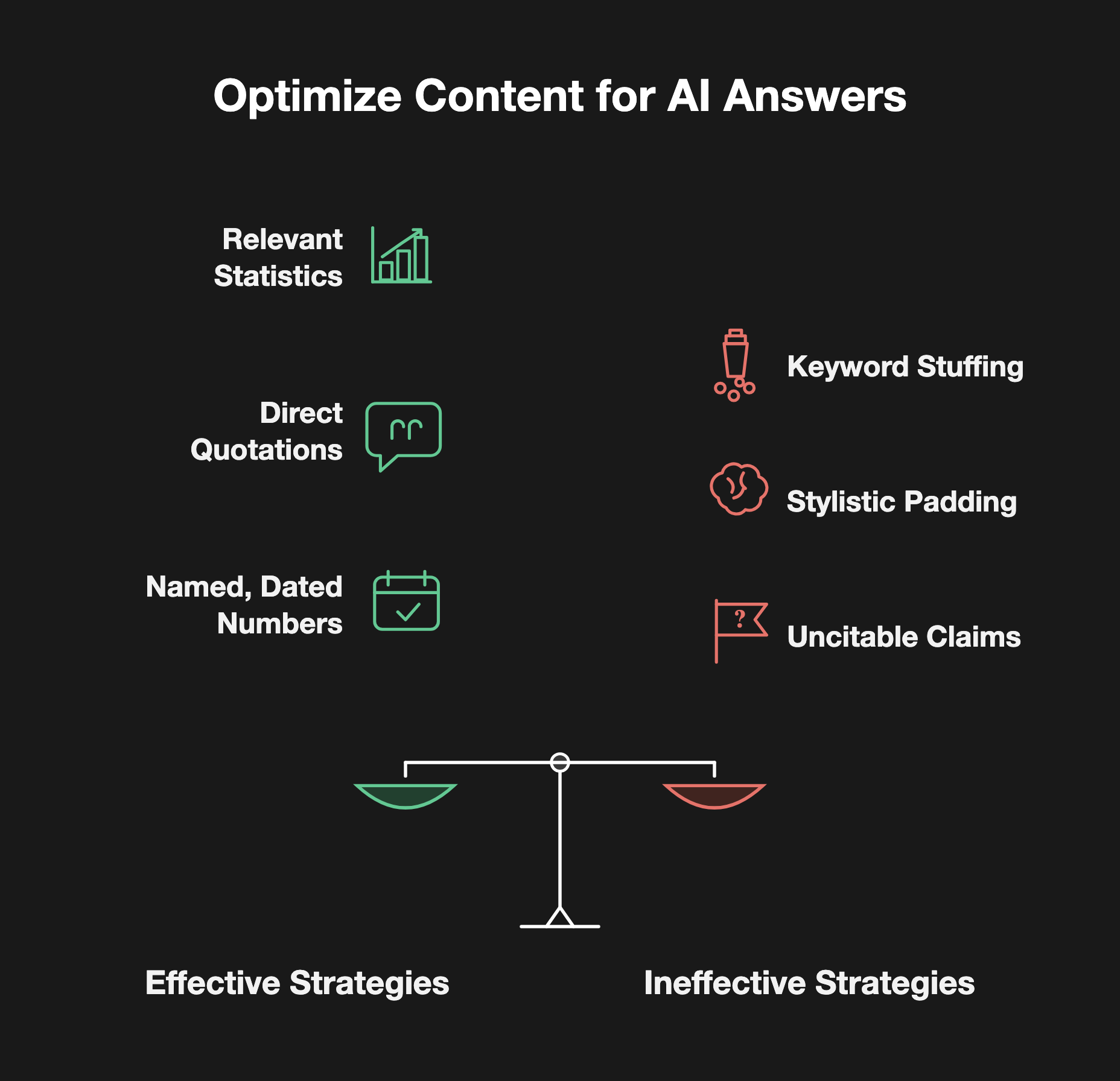
What the KDD 2024 GEO study found raises AI citation rates, set against the moves that do nothing.
Check 3: Is It Clear Who You Are
AI systems build a rough profile of your brand as an entity: who you are, what you do, what you are known for.
If your site never states that plainly, the model has nothing to attach a citation to. “We help teams do more” tells it nothing. “JB Martyn is a freelance content and SEO consultant for B2B software companies” tells it exactly where you fit.
Check 4: Does Anyone Else Say It Too
Models weight claims that show up in more than one place. A statistic only you report is riskier for the system to repeat than one echoed on Reddit, in a roundup, or on a review site.
This is why so much AI visibility happens off your own domain, which is the next section.
The common assumption is that if you rank #1, AI will cite you by default.
The Moz and Ahrefs numbers kill that. In Google’s AI Mode, 88% of citations sit outside the organic top 10. The #1 result is not the default source. The clearest passage is.
| The check | Done poorly | Done well |
| Clean answer | Answer spread across 5 paragraphs | 3 sentence answer under a question heading |
| Proof | “This usually takes a while” | “This takes 4 to 8 months, per SearchScaleAI’s 2026 data” |
| Entity clarity | “We help businesses grow” | “X is a Y for Z” said in one sentence |
| Corroboration | The claim lives only on your site | The same point shows up on Reddit, G2, a podcast |
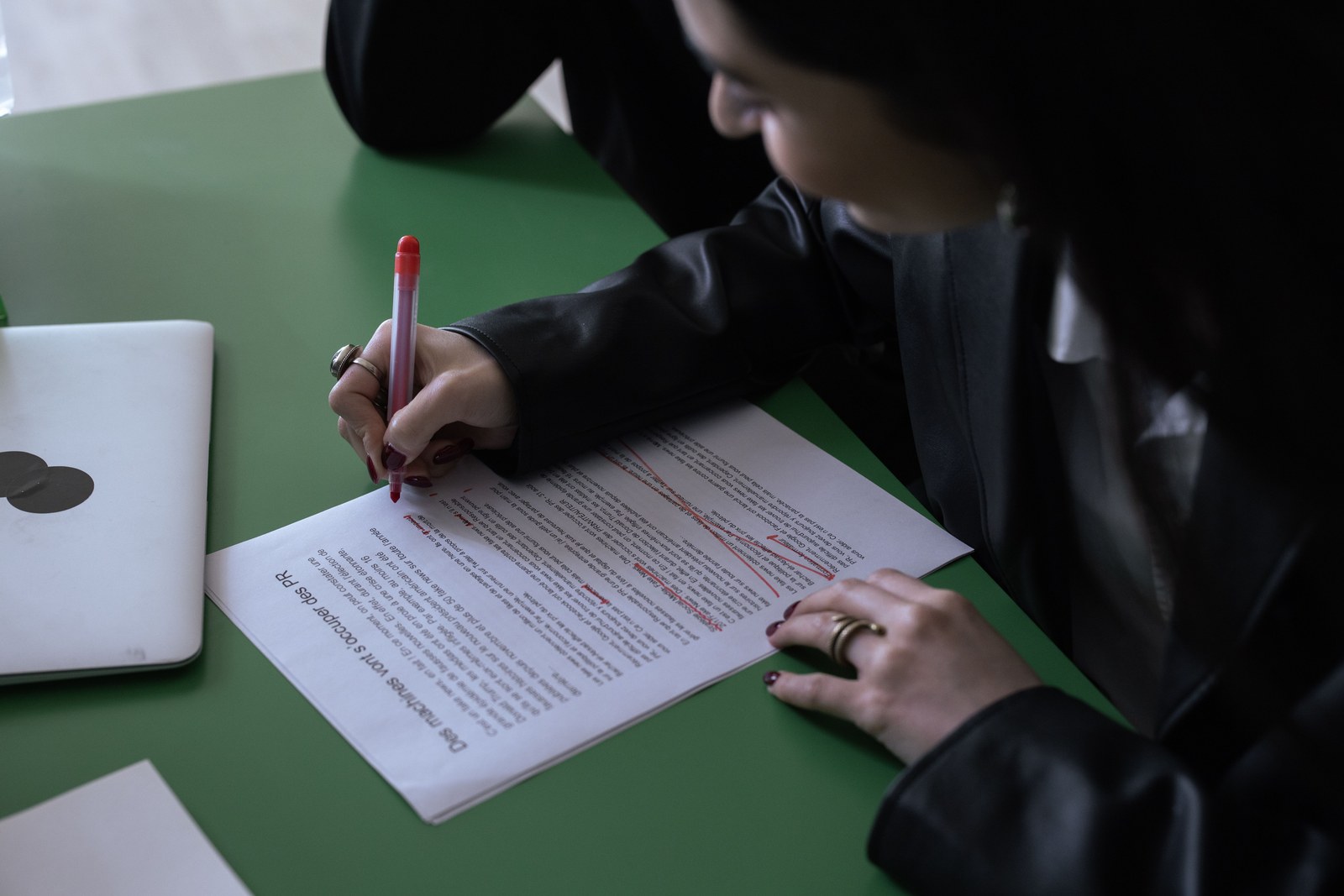
Editing a draft for passages a model could lift whole. Photo: Pexels.
What Content Actually Gets Pulled: Structure Beats Polish
The content that gets cited is not the most beautifully written. It is the most extractable. Short direct answers under question headings, a real statistic or quote in most sections, comparison tables, and a plain FAQ all give an AI system clean blocks to lift. A polished essay with no seams gives it nothing to grab, no matter how good the writing is.
The GEO study found the same thing from the data side. The moves that raised citation rates were structural: adding statistics, adding quotations, citing sources. The moves that did nothing were cosmetic: more keywords, fancier language.
This is the part good content work is now judged on. Not how it reads once. How cleanly a machine can take one piece of it and stand behind it.
Here is the difference on a single sentence.
Not citable: SEO takes a while before you see results.
Citable: SEO typically takes 4 to 8 months to reach break even, according to SearchScaleAI’s 2026 small business analysis.
Same point. One is a vague claim. The other is a dated, sourced fact a model can repeat with a citation attached. Build the second kind on purpose, in most sections.
A Section Rewritten to Be Citable
Take a paragraph most sites would write about cold email.
Before: Cold email still works if you do it right. Personalization matters a lot, and following up makes a big difference. Most people give up too early.
After: The average cold email reply rate in 2026 is 3.43%, per Instantly’s benchmark report. Personalized emails reply at 4% to 8%, and campaigns with 3 to 5 follow ups reply at 8.3% versus 4.1% with none. Most senders stop after 1 email and miss the 42% of replies that follow ups produce.
The “after” version is 3 citable sentences. Any one of them could land in an AI answer on its own. The “before” version has nothing a model would risk repeating.
The quick test
Read any section out loud and ask: is there one sentence here a stranger could quote with a source attached. If not, the section is not built to be cited yet.
| Content move | Effect on AI citation |
| Direct answer under a question heading | Helps, gives the model a clean block |
| Named, dated statistic in the sentence | Helps, up to 40% more visibility per the GEO study |
| Direct quotation from a source | Helps |
| Comparison table | Helps, easy for a model to parse |
| Plain FAQ section | Helps |
| More instances of your keyword | No effect per the GEO study |
| Longer, more elaborate prose | No effect |

The same section before and after it was rewritten to carry proof. Photo: Pexels.
Most of Your AI Visibility Happens Off Your Own Site
Here is the uncomfortable part. A large share of what AI engines cite is not brand websites at all. It is Reddit threads, YouTube videos, review sites, and roundups.
A 2026 analysis by Cognizo put third party sites at roughly 84% of AI citations. So part of getting cited is making sure the places models trust have something accurate to say about you.
Reddit is the single most cited domain across the major AI engines in 2026. For Google’s AI Overviews specifically, community and discussion sources like Reddit, YouTube, and Quora make up a large block of every answer, with Reddit alone near 21% of AI Overview citations in recent citation source tracking.
That does not mean spam Reddit. It means that when a real thread asks the question your business answers, a genuine, useful reply from someone at your company is worth more for AI visibility than another blog post on your own site.
The same logic covers the rest of your footprint:
- A case study with real client numbers in it
- A podcast appearance where you say something specific
- A mention in an industry roundup
- An honest G2 or review profile
Each one is another place the model can corroborate a claim about you.
| Where AI engines pull from | Rough share of citations | What to actually do |
| Third party sites overall | ~84% (Cognizo, 2026) | Be genuinely present and accurate where your buyers already are |
| Most cited single domain, ~21% of AI Overview citations | Answer real threads honestly, never astroturf | |
| Your own domain | The rest | Make every key page clean, sourced, and clear about who you are |

Community threads are among the most cited sources in AI answers. Photo: Pexels.
What to Do About It, in Order
You do not need a separate AI strategy or a new tool. You need to make your existing pages extractable and your brand legible to a model. Here is the order that returns the most for the least time, which matters when marketing gets whatever hour is left in your day.

Most of this is a rewrite pass on pages you already have, not a new project. Photo: Pexels.
- Pick 5 questions your buyers actually ask. Not keywords, questions, phrased the way they say them. Give each one a question heading and a 3 sentence answer directly under it.
- Put proof in nearly every section. One named, dated statistic, and where you can, one direct quote. If a section has no verifiable fact, it is not ready to be cited.
- State who you are in one plain sentence, on your homepage and your main service pages. What you do, who you do it for.
- Add a comparison table and a short FAQ where they genuinely fit. Both are formats models parse easily.
- Get corroborated off site. One honest Reddit answer, one case study with real numbers, one roundup mention. Repeat quarterly.
That list is most of what people mean by GEO services and AI search optimization services. The label is new. The work is mainly content built to a higher standard, with the model treated as a second reader alongside the human.
If you want a second set of eyes on which of your current pages could realistically get cited, and which need rebuilding first, email me directly or book a short call and we will run your key pages against the 4 checks above. You can also see the rest of what I do if AI visibility is one piece of a bigger content problem.
Real Questions About How AI Search Picks Citations, Answered
Yes. AI engines still need to find, crawl, and understand your page before they can cite it, and Google’s AI features pull from its own index. What changed is that ranking is now the entry ticket, not the finish line. Moz found in February 2026 that 88% of Google AI Mode citations come from outside the organic top 10, so strong SEO plus citable structure beats strong SEO alone.
A quotable sentence answers one clear question and carries something the model can stand behind: a specific number, a named source, a date, or a direct quote. “Response times vary” is not quotable. “The average cold email reply rate in 2026 is 3.43%, per Instantly’s benchmark report” is. The KDD 2024 GEO research found that adding statistics, quotations, and citations lifted AI visibility by up to 40%.
Generative engine optimization structures content so AI answer engines can extract and cite one clean piece of it. In practice that means direct answers under question headings, a verifiable fact in most sections, plain statements of who you are, and third party corroboration. The KDD 2024 GEO study found those moves lift a page’s visibility in AI answers by up to 40%, while extra keywords do nothing.
Because a real Reddit thread usually has a blunt, specific answer from someone with direct experience, echoed across many threads. That made Reddit the most cited single domain across major AI engines in 2026. A genuine, useful reply in a relevant thread from someone at your company can do more for AI visibility than another post on your own site.
Schema helps but it is not required. It gives the engine a cleaner read of your content type, author, and FAQ, which supports citation. Google’s own guidance on AI features says there is no special markup for AI Overviews and that normal structured data and helpful content practices apply. Clear writing and real proof matter more than any single tag.
There is no fixed timeline, but a page that is already indexed and gets rewritten to be citable can appear in AI answers within a few weeks, because the engines revisit and rewrite their answers often. A brand new page has to be found and trusted first, which is closer to the normal 3 to 6 month SEO curve. Consistent, sourced content over a few months is the realistic path.
They overlap heavily and are often used interchangeably. Answer engine optimization is usually framed around direct answer formats and featured snippets, while generative engine optimization, the label from the KDD 2024 research paper, is framed around being cited inside AI generated summaries. The practical work, clear answers plus proof plus corroboration, is nearly identical.
Partly. Tools like Profound, Peec, and Otterly track brand mentions and citations across ChatGPT, Perplexity, and Google’s AI features. You can also just ask the major engines the questions your buyers ask and see who gets named. It is less precise than Search Console, but the trend line is usually clear within a few weeks.