
How to Write a Case Study for a Service Business (And Why Most Never Do)

You have a folder of nice testimonials. “Great to work with.” “Delivered on time.” “Highly recommend!”
They are true, and they change almost NOBODY’S MIND.
A stranger comparing you to two other providers does not need to hear that you are pleasant. They need to see a business like theirs, with a problem like theirs, and what actually changed. That is what a real case study does, and most service businesses do not have a single one.
It matters more every year. In March 2026, a Gartner sales survey found that 67% of B2B buyers now prefer a buying experience with no sales rep involved at all.
If ⅔ of buyers want to decide before they ever talk to you, your proof has to do the talking.
So this is how to write a case study for a service business: what it needs, how long it runs, how to build one in an afternoon, and how to do it even when the client will not hand you a number.
Table of Contents
- A Case Study Beats a Testimonial Every Time
- What Should a Case Study Include? The 5 Parts, in Order
- The Mistake That Makes a Case Study Read Like a Brochure
- How Long Should a Case Study Be?
- Can You Write a Case Study Without Hard Numbers From the Client?
- How to Build One in an Afternoon
- Where to Put It So It Actually Gets Seen
- What to Do Next
- Real Questions About Writing a Case Study, Answered
A Case Study Beats a Testimonial Every Time
A testimonial says you were good to work with. A case study shows the starting problem, what you did, and the number or the outcome that moved, so a stranger can picture their own situation in it.
The one is a compliment, the other is evidence.
B2B marketers rank case studies the second most effective content type they produce, at 47%, just behind ebooks and white papers at 50% and ahead of social posts at 41%, according to the Content Marketing Institute’s 2025 B2B benchmarks report with MarketingProfs.
so, the gap is in the execution. The same research found that 73% of B2B marketers use case studies, but only about 34% of companies feel they use them well.
That is the opening, because most of your competitors have the same folder of testimonials you do. The real case study is the thing that almost none of them will ever bother to build.
| Testimonial | Case study | |
| What it proves | You were pleasant to deal with | You solved a specific problem |
| What the reader gets | A feeling | A situation they recognize |
| Length | One or two sentences | 600 to 1,000 words, or a short video |
| Where it wins | Social proof strip, footer | The decision moment, on the service page |

A quote reassures. A story lets a buyer step in. Photo: Pexels.
What Should a Case Study Include? The 5 Parts, in Order
A case study needs 5 parts, in this order: the client and their problem, what you did, the result with a real number, a direct quote from the client, and one line on what it means for the reader. Miss the problem or the number, and it stops being evidence.
1. The client and the starting problem
Name the client if they allow it, or describe them precisely if they do not: “a 12-person accounting firm losing two days a month to manual onboarding.” The reader has to see themselves here or they stop reading.
2. What you actually did
Not your whole methodology. The two or three decisions that mattered. “We cut the intake form from 40 fields to 9 and moved it before the first call.”
3. The result, with a real number
Time saved, revenue added, a rate that moved, a process that stopped breaking. A number anchors the whole piece. “Onboarding dropped from 6 days to 1.”
4. A direct quote from the client
In their words, about the change, not about you. “I stopped dreading Monday mornings” beats “the team was professional.”
5. What it means for the reader
One sentence that connects it to the person reading: “If your onboarding still runs on email threads, this is the fix.”
The same result, written two ways
Vague: After working with us, the client saw a significant improvement in their lead flow over the following months.
Specific: In the 90 days after launch, the client went from 4 booked calls a month to 11, at the same ad spend.
Same fact. One is a claim a reader skips. The other is a sentence a reader, and an AI answer engine, can quote.
Why the specific version wins
The specific line names a real quantity, a timeframe, and holds the ad spend constant, so a reader can test it against their own situation. The vague line asks them to take your word for it. Because AI answer engines have the same preference, they lift the sentence that carries a checkable number.

Five headings, one number, one quote. The structure is the whole trick. Photo: Pexels.
| Part | Weak version | Strong version |
| Problem | “The client needed help with marketing” | “Leads dropped 40% after their top referral source retired” |
| What you did | “We ran a full-funnel strategy” | “We rebuilt three service pages and added one case study” |
| Result | “Things improved” | “Booked calls went from 4 a month to 11“ |
| Quote | “Great communication throughout” | “We finally have a website that sells while I sleep” |
The Mistake That Makes a Case Study Read Like a Brochure
The most common mistake is leading with your process instead of the client’s problem. A reader does not care that you ran a discovery workshop. They care that the firm in the story was losing two days a month and now is not.
The second mistake is making the client generic. “A business needed more leads” could be anyone, so it is no one. “A 12-person accounting firm that lost its top referral source” is a mirror.
The third is no number and no concrete change, just adjectives. If the strongest line in your case study is “the client was thrilled,” it is a testimonial wearing a longer outfit.
Fix all three and you are ahead of most of the field, because most competitors will never move past the testimonial folder.
How Long Should a Case Study Be?
A written case study should run 600 to 1,000 words, or a video should run 1 to 2 minutes. That is long enough to carry the problem, the work, and the result, and short enough that a buyer who is comparing three providers actually finishes it.
Skimmable beats thorough. Use a heading for each of the five parts, put the number in its own line, and pull the client quote out so the eye lands on it. A busy owner reads the headings and the quote first, then decides whether to read the rest.
Written or video matters less than finished and specific. A written case study is easier to skim, easier to quote, and easier for a search engine or an AI answer to pull one sentence from. A short video adds a face and a voice, which helps at the very end of a decision. If you only have time for one, write the page and add the video later.
If you have real before-and-after screenshots, a short workflow diagram, or a chart, add one. One visual that shows the change is worth 200 words describing it.

Built to be skimmed: headings, one number, one pulled quote. Photo: Pexels.
Can You Write a Case Study Without Hard Numbers From the Client?
Yes. When a client will not share revenue or conversion data, build the result around time saved, a before-and-after workload, a process that stopped breaking, a deadline they started hitting, or their own description of the change. A specific qualitative result still beats a vague quantitative one.
Here is my process. I push for the numbers harder than feels polite. I ask on the call, I ask again in the follow-up email, and I keep asking to the point of being a little annoying, because a client who can see their own result written down is a client who renews. Most of the time that persistence turns up a number I was first told did not exist.
When it genuinely does not, I build the result from what the client will stand behind: hours back in the week, a deadline they now hit, a process that stopped breaking, a hire they did not have to make. Then I make that one small real detail carry the weight instead of burying it, and I have the client approve the exact wording in writing.
Two rules when the numbers are soft. Never estimate a figure and present it as measured. And get the client to approve the exact wording of their result and their quote in writing, so nothing in the published piece is a surprise.
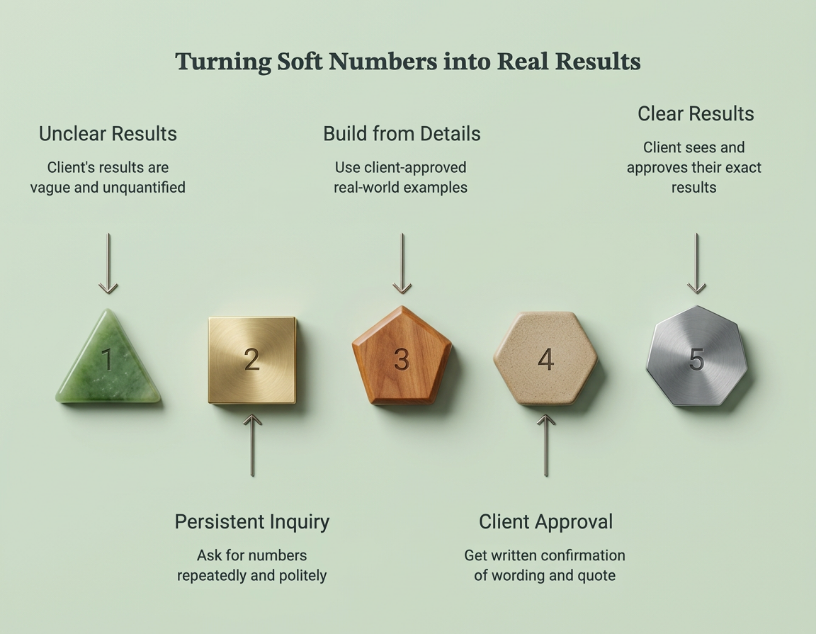
The path from “the client won’t share numbers” to a result you can publish. Five steps, in order.
You can see samples of how I write for a sense of how this reads when the client is named and when they are not.
How to Build One in an Afternoon
You do not need a project. You need one 30-minute client call and a focused draft. Here is the order.
- Pick the client with the clearest before and after. Not your biggest client, the one whose problem is easiest for a stranger to recognize.
- Ask 6 questions on a call. What was breaking before you called us. What had you already tried. What did we change first. What is different now, in a number or a specific. What surprised you. What would you tell someone weighing this decision.
- Draft in the five-part order above. Problem, what you did, result, quote, what it means. One heading each.
- Pull the number and the quote out. Put the number on its own line. Put the quote in its own block.
- Send the client the draft, not just the quote. Ask them to correct anything and approve the result wording in writing.
- Publish it where buyers decide, not just on a hidden portfolio page. More on that next.
The whole thing is a call, a two-hour draft, and one round of client edits. Compare that to the return: it is the asset that keeps selling for years.

Thirty minutes of the client’s words is most of the work. Photo: Pexels.
Where to Put It So It Actually Gets Seen
Put the case study on the matching service page, in every proposal, and linked from your About page, with one case study per service line. A case study buried on a portfolio page that nobody visits does not influence anything.
Gartner’s B2B buying research found that buyers spend only 17% of their total buying time meeting with any potential supplier, and roughly 45% of it researching on their own. The case study has to be sitting on the page they research, not waiting behind a “Portfolio” tab.
One rule of thumb: do not hide it behind a form. A case study is proof, not a lead magnet. Gating it means the buyer who was almost convinced hits a wall and leaves. Let it be read, and put the contact link at the end of it.
| Where | Why it works |
| On the service page it relates to | The buyer is already there, deciding |
| Inside every proposal | Turns “trust me” into “here is proof” while they read |
| Linked from the About page | The About page is where a skeptic goes next |
| One per service line | A web-design buyer wants a web-design story, not a copywriting one |
The proposal placement is the one people skip and the one that converts hardest.
When a prospect is reading your proposal, they are already leaning in.
A short case study box next to your price, showing a comparable client and their result, is the difference between “let me think about it” and “let us start.”

The case study belongs on the page where the buyer is already deciding. Photo: Pexels.
What to Do Next
If you have an hour, spend it picking the client and writing the 6 questions. That is the hard part started.
Most small business owners do not have much more than that. PostcardMania’s 2025 research found that 56% of small businesses have one hour or less per day for marketing. One case study, built in one afternoon, is the highest-return use of that hour you will find.
If you want the interview run and the piece written for you, in your voice, with the client wording handled properly, email me directly or book a short call and we will start with the client who has the clearest story.
You can also see the rest of what I do if the case study is one piece of a bigger content gap.
Real Questions About Writing a Case Study, Answered
A case study is a short, structured account of one client’s problem, the work you did, and the measurable result, ending with a direct client quote. It is the single most persuasive proof asset a service business can own: B2B marketers rank it the second most effective content type they produce, at 47%, per the Content Marketing Institute’s 2025 benchmarks.
A good case study has five parts in order: the client and their starting problem, the two or three things you actually did, the result stated as a real number, a direct quote from the client about the change, and one line on what it means for the reader. Most published B2B case studies skip the problem or the number, which turns them back into brochures.
A written case study should be 600 to 1,000 words, or a video 1 to 2 minutes. That is enough to carry the problem, the work, and the result, and short enough that a buyer comparing three providers finishes it. Use a heading per section and pull the key number and the client quote out so the piece survives a skim.
Build the result around time saved, a before-and-after workload, a process that stopped breaking, or the client’s own description of the change. Content Marketing Institute’s 2025 B2B benchmarks found that only about 34% of companies feel they use case studies well, so a specific qualitative result still beats most of what buyers see. Never estimate a figure and present it as measured.
Aim for one strong case study per service line, so three to five total for most small service businesses. A web-design buyer wants a web-design story, not a copywriting one. One that a stranger can step into beats five thin ones, so start with the client whose before-and-after is easiest to recognize.
A testimonial is a one or two sentence compliment about working with you. A case study is a 600 to 1,000 word account of a specific problem, the work, and a measured result. A testimonial creates a feeling; a case study gives a buyer a situation they recognize and a number they can repeat to a colleague.
Yes, after one completed client engagement with a clear before and after. You do not need years of history or a famous logo. You need one client whose problem is easy for a stranger to recognize and who will approve their result wording and a short quote in writing.
I ask right after a clear win, while the result is still fresh, and I keep the request to one 30-minute call. I offer to anonymize them (“a 12-person accounting firm”) if they cannot be named, and I send the full draft to correct rather than a quote to approve. Almost every client says yes when the ask is that small and that controlled.