
How Much Time Does Content Batching Actually Save a Small Business?

You know you are supposed to post consistently.
But you also know that the three platforms you are supposed to be on this week got nothing, because a client call ran long and then the week ran out.
That is definitely not a discipline problem. It is a batching problem, and fixing it does not take a personality change, it takes one afternoon run the right way.
In the 2025 Sprout Social Index, 94% of social media practitioners said they have to be chronically online just to keep up, and a third name burnout and creative fatigue as their single biggest fear on the job.
If a team of professionals whose entire job is social media feels that way, a solo business owner squeezing it in between client work does not stand a chance doing it live, one post at a time.
So here is the honest math on content batching: what it actually saves, why most of the “saves you X hours” claims floating around cannot be traced to a real source, and the step-by-step way to run one batching day that actually holds.
Table of Contents
- The Real Reason “Just Post More” Burns Small Business Owners Out
- What Content Batching Actually Is (And Is Not)
- The Real Cost of Constant Task Switching
- So How Much Time Does Batching Actually Save? The Honest Math
- Why Most Solo Businesses Never Get Around to It
- How to Run a Batching Day, Step by Step
- What to Batch vs What Still Needs to Happen Live
- Where the Batched Work Should Actually Go
- Real Questions About Content Batching, Answered
The Real Reason “Just Post More” Burns Small Business Owners Out
Most solo business owners are not ignoring social media. They are trying to do it the hardest possible way: live, one post at a time, context-switching away from client work every single time.
Simply Business’s June 2025 survey of 1,023 US solopreneurs found that 42% have given up time with family and friends to keep the business running, and 53% already use some marketing or social media tool to try to manage it. The tools are not the missing piece. The outdated method is.
“Post more consistently” is advice that assumes the problem is motivation. Newsflash, It’s not.
The problem is that live posting makes you pay the full mental cost of switching tasks every time you sit down to write one caption.
What Content Batching Actually Is (And Is Not)
Content batching is doing all the thinking and writing for a stretch of content in one protected block of time, then queuing it to go out later. It is not the same thing as scheduling.
Scheduling is just picking a future time for a post to publish. You can schedule one post written in isolation, and most people do.
Batching is what happens before that; it’s:
- A single sitting where you write, design, and finish a week’s or a month’s worth of posts back to back.
- Your brain only paying the setup cost of “now I am in content mode” once, not five separate times.
A scheduler is the tool. Batching is the method. You can own a scheduler and still never batch, which is most of what the 53% figure above actually describes.
The difference shows up clearly across a real week. A scheduled-but-not-batched week looks like this:
- Monday you write Monday’s post,
- Wednesday you write Wednesday’s,
- Friday you write Friday’s,
Three separate sit-downs, three separate cold starts.
A batched week looks like this: one Monday morning, you write all three in order, back to back, then queue all three before lunch. Same scheduler, same three posts, a completely different amount of mental cost to produce them.
Talk about Working smarter, eh? : )
The Real Cost of Constant Task Switching
The hidden cost of live, one-off posting is not really about social media at all. It is about what switching tasks does to a brain, documented well outside the marketing world.
The American Psychological Association’s research on multitasking found that switching between tasks can cost up to 40% of someone’s productive time, driven by the mental work of dropping one task’s goal and loading another’s.
Separate research out of the University of California, Irvine found it takes an average of 23 minutes to fully refocus after an interruption.
Stop and write one social post between two client tasks, and you are not paying the cost of writing the post.
You are paying the cost of two interruptions: the one that pulled you out of real work, and the one that pulls you back into it.
Say you write one caption at 10am. On paper that cost 15 minutes.
In practice, the task you stepped away from, a client proposal, a brief, an invoice, now needs its own 23 minutes to get back to full speed, so one 15-minute interruption quietly becomes closer to 38 minutes of real lost time once you count the trip back.

The post itself takes five minutes. Getting back to what you were doing takes longer. Photo: Pexels.
So How Much Time Does Batching Actually Save? The Honest Math
There is no single honest answer, because it depends on how many platforms you post to and how often. What there is, is a real way to calculate your own number, which is more than most of what gets published on this question.
What manual posting actually costs you in a week
Say you post to 3 platforms, 3 times a week each, and each individual post takes about 15 minutes of actual writing once you factor in finding an image and getting the caption right. That is 9 posts, 135 minutes of pure task time.
Add the 23-minute refocus tax even half the time you get interrupted doing it, and the real weekly cost runs closer to 3 hours, most of it invisible on a calendar.
What the same content costs you batched
The same 9 posts, written in one sitting with no client work in between, typically take 60 to 90 minutes total, because you pay the 23-minute setup cost of “getting into content mode” exactly once instead of nine times.
A worked example, three platforms, three posts a week
| Manual, live posting | Batched, one sitting | |
| Posts written | 9 | 9 |
| Pure writing time | ~135 minutes | ~75 minutes |
| Refocus tax paid | Up to 9 times | Once |
| Realistic weekly total | ~3 hours | ~1 to 1.5 hours |
Why the batched version is faster than the math alone explains
The raw writing time only drops modestly. The real saving is in how many times you pay the 23-minute refocus tax to get back into client work afterward.
Batching does not just save writing minutes, it protects the rest of your day from being interrupted nine separate times instead of once.
That protection compounds in a way a single week’s math does not show. A client proposal written without nine separate social-media interruptions running through it is not just faster, it is usually recommended and better, because the person writing it never had to reload their own train of thought from scratch.
The real return on batching shows up as much in the quality of the work around it as in the minutes the batching itself takes.
Why Most Solo Businesses Never Get Around to It
No, I know what you’re thinking and It is not laziness. Simply Business’s same 2025 survey found that 61% of solopreneurs underestimated the challenge of managing every part of the business alone, social media included.
PostcardMania’s 2025 research found that 56% of small businesses have one hour or less per day for marketing. One hour a day, spent live and reactively, never adds up to one protected batching block. It gets eaten by whichever task is loudest that day, which is almost never social media.
The other reason is less about time and more about mode. Batching asks you to think like a content creator for 90 straight minutes, a different mental mode from delivering client work, and switching into that mode cold, without planning for it, feels harder than it should.
So the block gets skipped in favor of whatever task feels more urgent in the moment, and the week ends the same way it always does.

The hour exists. It just never survives contact with the rest of the day. Photo: Pexels.
How to Run a Batching Day, Step by Step
You do not need a full day. You need one protected 90-minute block, ideally the same time every week or every other week. The shift is not in how much content gets made, it is in how many separate sit-downs that content costs you.
| A scattered week | A batching day | |
| Sit-downs required | 9, one per post | 1 |
| Mental mode switches | Up to 9 | 1 |
| When it happens | Whenever a gap appears | One protected block |
| Likely outcome | Posts skipped most weeks | A full stretch of content, done |

The block has to exist on the calendar before it can protect anything. Photo: Pexels.
- Block the time on your calendar like a client call. Not “whenever I get a chance.” A real block, with a start and an end.
- Pick your 3 to 5 themes for the stretch. A tip, a client result, a behind-the-scenes moment, an opinion, an answer to a question you got that week.
- Write all the captions first, before touching a single image. Writing and designing are different mental modes. Do not switch between them post by post.
- Source or shoot all the images second, matched to the captions you already wrote.
- Load everything into the scheduler in one pass. This is where the tool earns its keep, after the thinking is done, not instead of it.
- Leave the live, reactive work for the week itself. Replies, comments, and anything genuinely time-sensitive still happen in real time. Batching replaces the writing, not the conversation.
What to Batch vs What Still Needs to Happen Live
Not everything belongs in a batch. Some content only works in the moment, and forcing it into a queue makes it feel stale or tone deaf.
| Batch it | Keep it live |
| Tips, how-tos, educational posts | Replies to comments and DMs |
| Client results and testimonials | Anything tied to a real-time event or trend |
| Behind-the-scenes and process posts | Customer service questions |
| Recurring series (FAQ Friday, a weekly stat) | A genuine announcement that cannot wait |
Remember, the rule of thumb is, if the post would read exactly the same whether it went out today or in 10 days, it belongs in the batch.

No client tabs open, no notifications. One mode at a time. Photo: Pexels.
Where the Batched Work Should Actually Go
Batching only pays off if what comes out of it is actually good enough to post, not just fast to produce. A rushed caption written in one sitting is still a rushed caption.
That is the gap between batching as a time-saving trick and batching as a real system: the themes, the voice, and the offer behind each post still have to be worked out properly, the same way any other piece of content does.
The batching day is faster because that thinking already happened once, not because it got skipped.

The batching is done. From here, the posting is automatic. Photo: Pexels.
If social media has been the thing that never survives your week, email me directly or book a short call, and I will help build a batching system (with my small team) around the one hour you actually have, not the 8 you do not.
You can also see the rest of what I do if content has been one piece of a bigger gap.
Real Questions About Content Batching, Answered
For a typical solo business posting to 3 platforms 3 times a week, batching cuts a roughly 3-hour week of scattered, live posting down to about 1 to 1.5 hours in one sitting. The number scales with how many platforms and posts you run, but the pattern holds because batching removes the repeated 23-minute refocus cost documented in University of California, Irvine interruption research, not just the writing time itself.
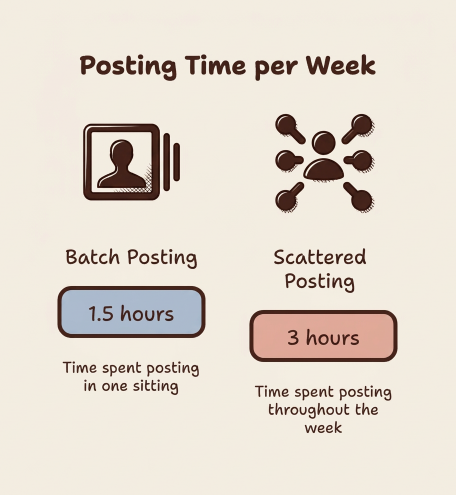
Posting time per week, using the illustrative math in this post: about 1.5 hours batched in one sitting versus about 3 hours scattered across the week.
Yes, but only once you are already batching, since a scheduler just queues content that was written well. Over half of solopreneurs already use a marketing or social media tool, per Simply Business’s 2025 survey of 1,023 US solopreneurs, yet most still post reactively, which means the tool is not the bottleneck most of them need solved.
Batching is writing and designing a stretch of content in one sitting; scheduling is picking when each finished piece goes out. You can schedule a single post written in isolation, but you cannot batch without eventually scheduling, since the whole point is to finish the thinking once and let the posts publish over time.
Once every 1 to 2 weeks is realistic for most solo businesses, producing 1 to 2 weeks of posts per session. Batching monthly in one marathon sitting tends to produce stale, generic content by the third week, while batching daily defeats the purpose, since you are back to paying the refocus cost every time.
Replies to comments and direct messages, anything tied to a real-time event or trending moment, and genuine customer service questions should never be batched. Sprout Social’s own content batching guide makes the same distinction: batching replaces the writing and planning, never the real-time conversation a follower actually expects a response to.
Yes, and it is about reader trust more than any platform algorithm trick. 79% of consumers say they are more loyal to brands with consistent communication, according to Capital One Shopping Research. A follower who sees a business post sporadically and then disappear for three weeks reads that as a business that might not follow through on anything else either, including the service they are considering buying.
Start with one 90-minute block and 3 post themes, not a full content calendar on day one. Pick a single recurring slot, the same morning every other week, write the captions first, source images second, and load the scheduler last. The system gets more sophisticated after the habit sticks, not before.
I treat it the same way I treat a client’s: one protected block, themes picked first, captions written before a single image is touched. I will not pretend I hit every two-week target perfectly, client deadlines sometimes win, but the moment I abandon the block entirely is the moment my own content goes quiet too, which is exactly the pattern this post is about.