
Why Ministry and Nonprofit Websites Shouldn’t Read Like a SaaS Homepage

You publish a new page for your ministry or nonprofit.
You read it back a week later.
It could belong to any software company in the country. “Empowering communities, driving impact together.” There’s nothing on the page that sounds like the people actually doing the work.
That is not a small style problem. Content writing is the actual product a donor or a new member buys before they buy anything else, trust in your specific voice.
You already have less time than most business owners to fix it.
Nonprofit CEOs and executive directors who say burnout is “very much” a concern jumped to 46% in 2026, up from 29% in 2025, according to the Center for Effective Philanthropy’s State of Nonprofits 2026 report.
You might not have a marketing department to blame this on. You have only you, a volunteer who is “good with words,” or whoever built the site 3 years ago.
So the SaaS voice creeps in because it is the path of least resistance, not because anyone chose it on purpose.
Table of Contents
The Real Cost of Sounding Like Everyone Else
Generic, corporate sounding copy costs a nonprofit or ministry the one thing it actually sells, proof that this specific mission is real. Donors say so directly.
58% of donors point to impact data and statistics, and 69% point to transparency in financial and program reporting, as the clearest signals an organization is legitimate, according to Bloomerang’s Giving Signals Report 2026.
Read that second number again. 69%. Not a slogan. A specific thing donors say they look for and rarely find.
A page written like a SaaS homepage cannot give them either one. It has no proof, no specifics, no names.
Most boards assume “polished” means sounding like a bigger, more corporate organization.
Donors read it the opposite way. A page with no specific proof on it reads as less credible, not more, which is exactly the outcome the polish was supposed to avoid.
| What the page says | What the donor actually needs to see |
| “Empowering communities together” | Which community, and what changed for them |
| “Driving impact through innovative programs” | One program, one number, one name |
| “A trusted partner in the mission field” | Who trusts you, and why |
Vague language does not read as safe. It reads as unverified, and an unverified claim earns nothing.

A staff member reviewing her own organization’s website and not liking what she finds. Photo: Pexels.
Why the SaaS Voice Creeps In Anyway
The SaaS voice creeps in because 3 ordinary forces push toward it: a website template built for a business, a well meant edit toward “professional,” and a quiet fear that sounding too plain will look unprofessional. None of the 3 are anyone’s fault. All 3 are fixable once you can name them.
The Template Was Never Built for You
Most website builders ship default copy blocks written for a generic business. An organization fills in the blanks around “our mission” and “our values” without ever rewriting the sentence structure underneath, so the bones of the page stay corporate even after every word on top of them changes.
The “Professional” Edit
A board member or volunteer, trying to help, edits a real sentence toward something that sounds safer. Safer usually means blander, more corporate phrasing, the exact drift a 2023 State of Workplace Jargon Report from LinkedIn and Duolingo documented across ordinary workplaces, not just nonprofits, where 58% of professionals said their own coworkers overuse jargon and 60% had to look a phrase up just to understand a colleague.
If your own staff cannot parse a sentence without translating it, a stranger visiting your site for the first time certainly cannot.
The Fear of Sounding Too Plain
Plain is not the same thing as unprofessional. It is the opposite of forgettable.
A few signs your site has already drifted into SaaS voice:
- Every sentence could belong to a different organization if you swapped the name.
- No specific person, place, or number appears above the fold.
- The word “impact” shows up more than once before anything concrete does.
- A stranger reading it could not tell what you actually did this week.

This is exactly the register that creeps into nonprofit copy when a “professional” edit takes over. Photo: Pexels.
What Mission Driven Copy Actually Sounds Like
What is website copywriting actually supposed to do for an organization like this? Make a stranger believe the mission is real in under 10 seconds. Mission driven copy names the specific person, place, or moment the work touched, in plain language, the same way you would describe it to a friend after service on Sunday. It trades the word “impact” for the thing that actually happened.
The Same Sentence, Two Ways
Generic: “Our organization is committed to empowering underserved communities through innovative programming.”
Specific: “Last month, 40 families in our own zip code got a bag of groceries that did not run out before the next paycheck.”
Same organization. Same week. One version a stranger believes.
A few swaps that do most of the work on their own:
| Instead of this word | Write this instead |
| “Impact” | The actual number or outcome |
| “Community” | The actual neighborhood, group, or name |
| “Empowering” | What the person can now do that they could not before |
| “Innovative programming” | The name of the actual program |
A Worked Example: Rewriting One Real Homepage Line
- Name the actual person or group involved, instead of “the community.”
- Name the actual number or moment involved, instead of “impact.”
- Read the sentence out loud. Cut anything that would not survive being said to a member’s face.
I have written homepage copy for a ministry client and byline pieces for The Times of Israel, so this is not theoretical for me. The sentence that survives being read out loud is almost always shorter and more specific than the one that started on the page.
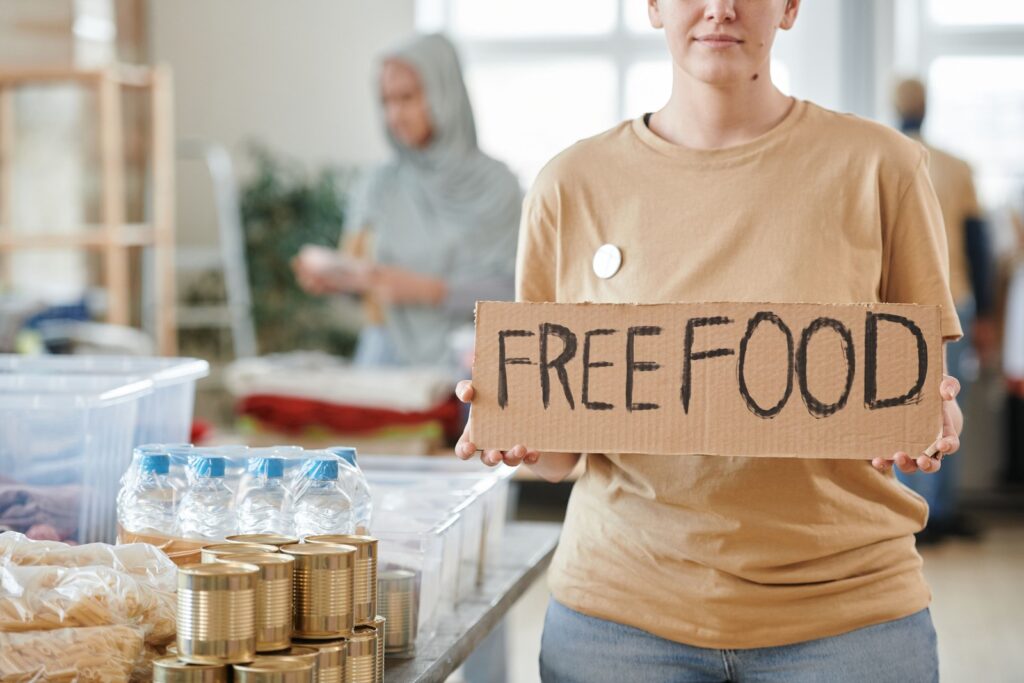
A real handoff, a real sign, a real Tuesday, the kind of specific detail generic copy leaves out entirely. Photo: Pexels.
Does This Actually Cost You in Search and AI Answers Too?
Yes, plain and specific language is worth more in search and AI answers than generic language, not less.
Here is the number that shows it. Only 11% of desktop visitors and 8% of mobile visitors who actually reach a nonprofit’s donation page go on to complete the gift, according to M+R’s 2026 Benchmarks report. Most people who make it that far still walk away, and vague copy earlier on the page is part of why.
A visitor who is not sure this is a real, specific mission does not finish the form. The page has to earn that trust in the first few seconds, the same seconds an AI answer engine spends deciding whether a sentence is worth quoting.
| Visitor type | Completes a gift |
| Desktop visitor to your donation page | 11% |
| Mobile visitor to your donation page | 8% |
| Mobile visitor, small nonprofit | 4% |
The same specificity that earns a skeptical human’s trust is what an AI answer engine looks for when deciding which sentence to lift. A vague line about “community impact” has nothing in it worth quoting. A sentence with a real number and a real place does.
If the technical side of your site, speed, structure, how a page is actually built, is part of the problem too, that is a separate audit. Web development work and copy work solve different halves of the same trust gap.

A supporter deciding, on a phone, in seconds, whether the page in front of them is worth trusting. Photo: Pexels.
What to Actually Do About It
You do not need to rewrite the whole site this month. Here is the order that actually works for a small, resource constrained team.
- Read your own homepage out loud today. Circle every sentence that could belong to another organization.
- Replace “impact” and “empowering” with the actual person, place, or number behind them.
- Get someone outside the organization to read it cold and tell you what confused them.
- Fix the homepage and the one page a stranger reads next, then stop. A full rewrite is not the goal this week.
That last point matters more than it sounds like it should, especially with 46% of nonprofit leaders already telling CEP that burnout is “very much” a concern in 2026. You do not have room for a project that never ends.
Compare your draft against jbmartyn.com. This site is written the same way I am telling you to write yours: plain, specific, and willing to name a real number instead of a vague claim.

A small team working through next steps together, one page at a time. Photo: Pexels.
If you want a second pair of eyes on your own homepage, specifically for this problem, email me directly or fill the form here and I will read it the way a first time visitor would, then tell you exactly which sentences to cut.
Real Questions About Nonprofit and Ministry Website Copy, Answered
Yes, because a mission driven visitor is evaluating the page for authenticity and proof of impact, not an efficiency claim the way a software buyer does. Bloomerang’s Giving Signals Report 2026 found 58% of donors point to impact data and statistics as a clear signal of legitimacy, a bar generic business phrasing cannot clear. Writing “we drive results” instead of naming who was actually helped answers the wrong question entirely.
You write mission driven content without sounding like a brochure by naming one real person, place, or number in every section, instead of a category like “community” or “impact.” A brochure describes a category. A real sentence describes one Tuesday. That distinction is the entire method, and it costs nothing to apply to a page you already have.
Nonprofit websites end up sounding the same because most are built on templates written for a generic business, then lightly edited by whoever has an hour to spare rather than rewritten from scratch. A 2023 State of Workplace Jargon Report from LinkedIn and Duolingo found 58% of professionals already think their own coworkers overuse jargon, so the drift toward safe, vague language happens everywhere, not only on nonprofit sites.
Yes, because M+R’s 2026 Benchmarks report found only 11% of desktop visitors and 8% of mobile visitors to a nonprofit’s own donation page complete a gift, and vague copy is a real part of that gap. Search engines and AI answer engines both reward the same specific, plain language a skeptical human donor responds to, so fixing one fixes the other.
Start with the homepage and the one page a first time visitor reads next, not the whole site at once. A resource constrained team rarely has time for a full rewrite, especially with 46% of nonprofit leaders telling CEP that burnout is “very much” a concern in 2026. Fixing the 2 pages a stranger reads first solves most of the trust problem the rest of the site inherited.
Yes, I have written homepage copy for a ministry client and byline pieces for The Times of Israel, so this register is not theoretical for me. You can see samples of how I write rather than take my word for it. Most copywriters offering this service have never written a sentence a congregation would recognize as their own.