
How to Write a Value Proposition in One Sentence (With a Template and 5 Before and After Examples)
You’ve been staring at the blank line under your homepage headline for an hour. It’s 11pm, and every version you write sounds like every other homepage you’ve ever read.
That line is your value proposition, and it decides whether the rest of your website copywriting gets read at all.
And the odds aren’t great. In June 2026, Wynter’s B2B vendor differentiation survey reported that 64% of B2B buyers find it difficult to tell vendors apart from their websites, and only 29% said a vendor’s messaging stood out when they built their shortlist.
Wynter sells message testing, so read that as a direction, not a decimal.
But the direction is hard to argue with.
So how do you actually write it? Here’s a template, 5 before and after examples and a test you can run before it goes live.
Table of Contents
- What Is a Value Proposition, and What Is It Not?
- Why Do Most Value Propositions Fail?
- How Do You Write a Value Proposition in One Sentence?
- What Do Good Value Proposition Examples Look Like?
- Where Should a Value Proposition Go on Your Website?
- How Do You Test a Value Proposition Before You Publish It?
- Real Questions About Writing a Value Proposition, Answered
What Is a Value Proposition, and What Is It Not?
A value proposition is one sentence that tells a specific buyer what result they get and why you’re the one to get it from. It isn’t your tagline, your mission statement or a list of features. It’s the promise a stranger needs to hear before they’ll read anything else.
People mix up 4 things that sound alike, and they aren’t the same job.
| Term | What it does | Length | Example (made up) |
| Value proposition | Tells the right buyer what they get | 1 sentence | “I help ecommerce founders know their real profit each month, without learning accounting.” |
| Tagline | Makes you memorable | 3 to 7 words | “Numbers, made human.” |
| Unique selling proposition | Claims the one thing rivals can’t | 1 claim | “The only bookkeeper who sends a 1 page profit report by the 5th.” |
| Positioning statement | Guides your team (internal) | 2 sentences | “For ecommerce founders who… unlike spreadsheets, we…” |
(Every example in this post is one I made up for illustration. None is a client or a real company.)
Geoffrey Moore’s positioning template from Crossing the Chasm (1991) is the long version of that last row. A fill in the blank form, commonly credited to Steve Blank, is the short one: “We help X do Y by doing Z.”
Use the long one for your team and the short one for your homepage.
So what separates a value proposition from a unique selling proposition? A USP is a single claim your rivals can’t make (“the only…”), so it needs proof. But a value proposition is the whole promise, and it works fine without “only”. If you can’t back up a USP yet, that’s okay, because a clear promise beats a shaky claim.

The first draft always starts on paper, or a sticky note. Photo: Pexels.
Why Do Most Value Propositions Fail?
Most value propositions fail because they describe the company instead of the buyer’s problem, so a visitor can’t tell what you do before they leave.
You get roughly 10 seconds to fix that. After that, many visitors are already gone.
Jakob Nielsen’s analysis of Microsoft Research data on 205,873 web pages found users often leave within 10 to 20 seconds. His advice for holding them longer: “you must clearly communicate your value proposition within 10 seconds.”
A B2B study from 2015 says the same thing from the buyer’s side. In KoMarketing’s 2015 B2B Web Usability Report, 46% of buyers said a “lack of message” (they couldn’t tell what a company does) was enough to make them leave a website.
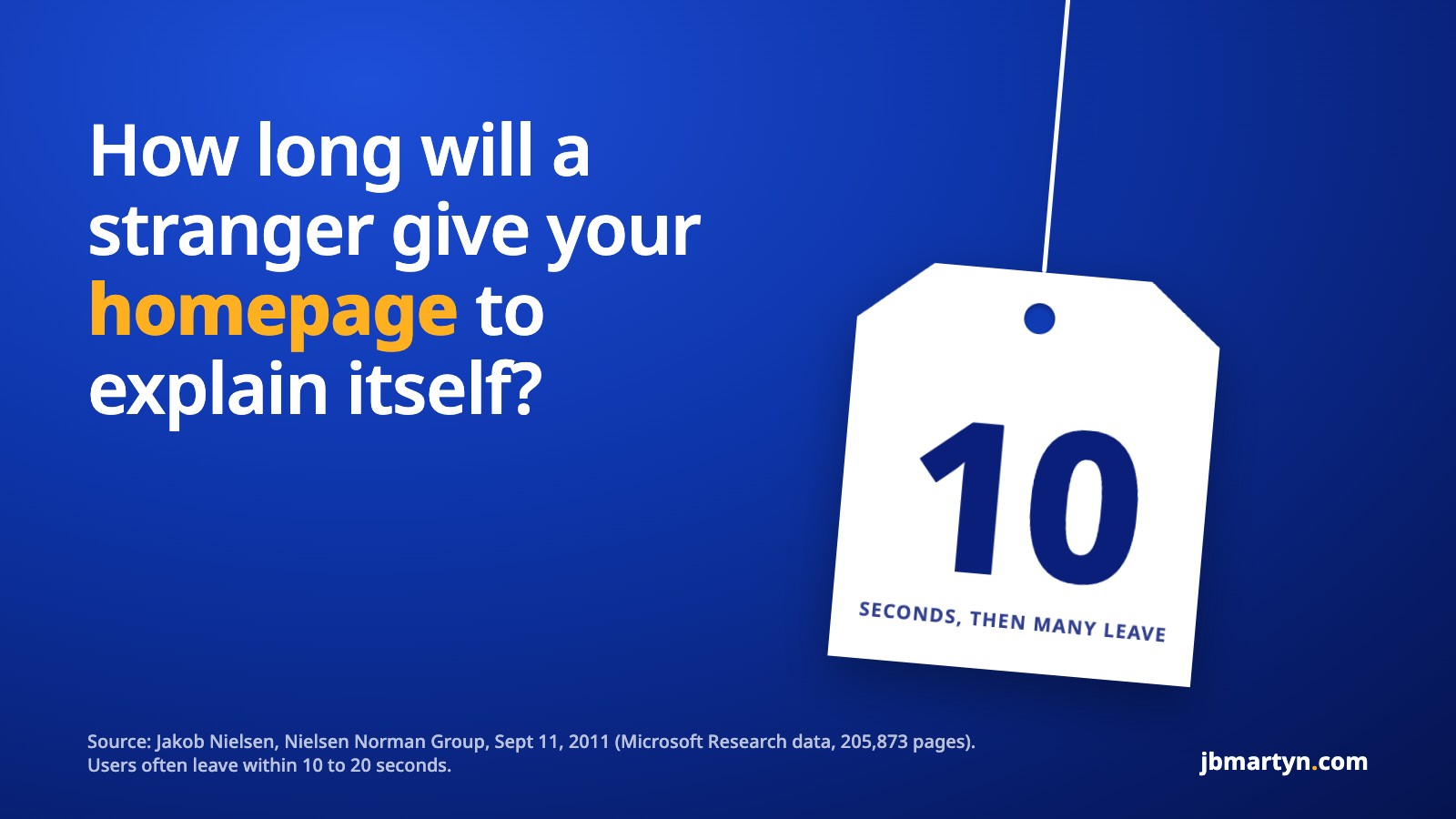
The clock starts the moment the page loads. Custom graphic.

A visitor on second 8, still not sure what you sell. Photo: Pexels.
Newer data points the same way. Wynter’s 2026 Sameness Benchmark scored the average category leader’s B2B homepage 56.6 out of 100 for sameness, across 445 sites in 61 categories, and found only 12.1% of its messaging is something no competitor says.
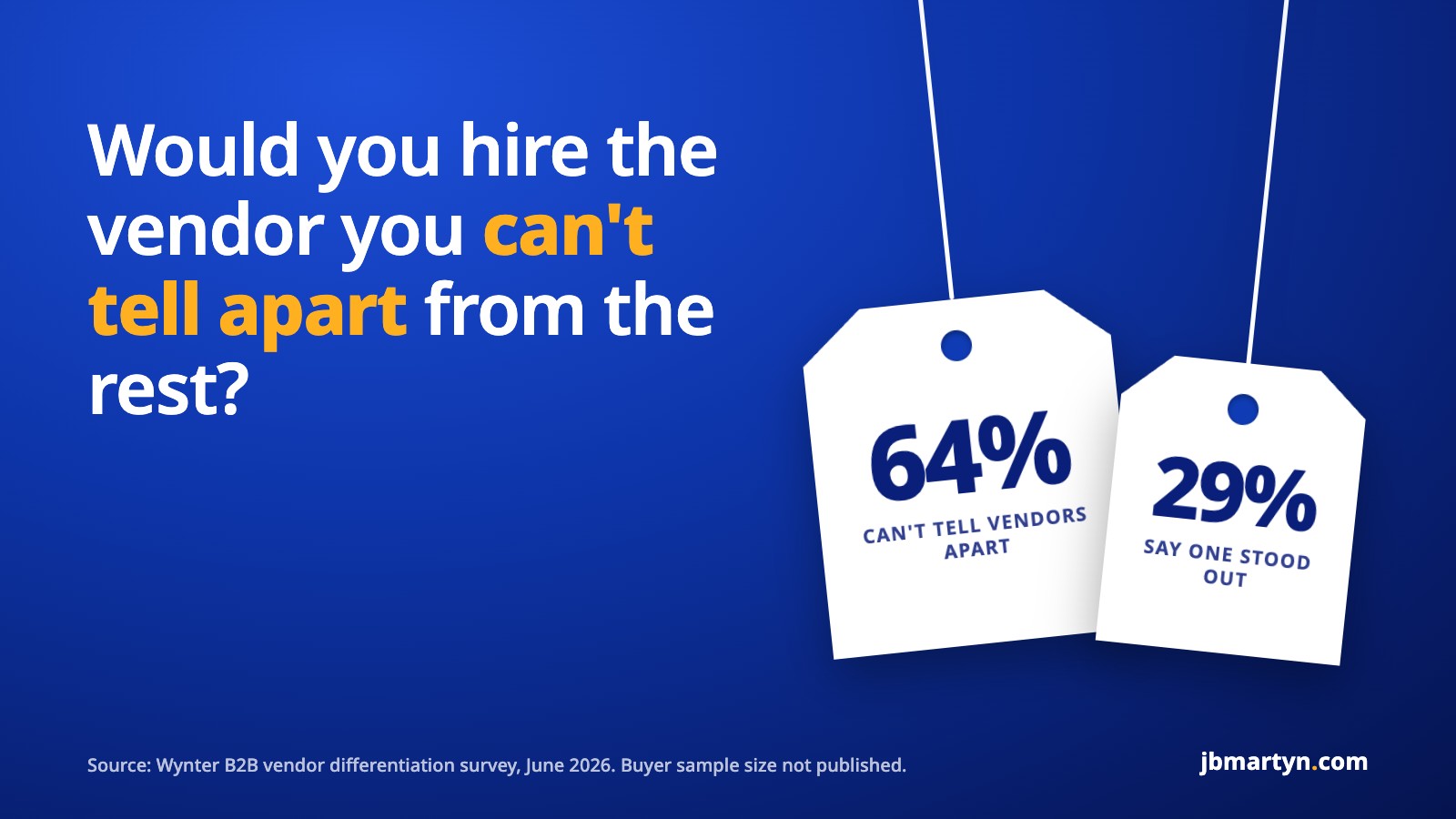
Most buyers can’t tell vendors apart, and few say anyone stood out. Custom graphic.
| Source | What it found | Year |
| Wynter | 64% can’t easily tell vendors apart by their websites | 2026 |
| Wynter | Only 12.1% of average homepage messaging is unique | 2026 |
| KoMarketing | 46% leave when they can’t tell what a company does | 2015 |
| Nielsen Norman Group | State your value within 10 seconds | 2011 |
So what do most people do? They reach for a clever line, which is the wrong fix. Clever isn’t clear, and a stranger in a hurry needs clear.
Compare these two. Clever: “Where work finds its wings.” Clear: “I help ecommerce founders know their real profit each month, without learning accounting.”
How Do You Write a Value Proposition in One Sentence?
Fill in 3 blanks: “I help [a specific person] [get a specific result] by [your way of doing it].” Then cut every word a competitor could also say, and read it aloud once. Say “I deliver innovative solutions” to a stranger at a party and watch them drift toward the snacks. If it sounds silly out loud, rewrite it.
Let’s go one blank at a time.
1. Name the person, not the industry
“Small businesses” isn’t a person. “Solo consultants who bill 20 hours a week” is. The narrower the person, the more likely they’ll stop and read.
2. Name the result in their words
Read your last 5 reviews, sales emails or discovery call notes, and steal the phrase they used. Buyers describe the problem better than you will.
3. Add your how, only if it’s different
Skip it if the how is the same as everyone else’s. “By using a proven process” tells nobody anything. But a specific how (“in a 1 page report by the 5th”) earns its place.
4. Check it against the 3 questions
Can a stranger answer 3 things from your sentence? Who is this for, what do I get, and why this person. If one answer is missing, you’ve found what to fix.
5. Cut it, then read it aloud
Take out every adjective. Does the sentence still work? Then leave them out. Plain words help too, since Unbounce’s 2024 data (more on that below) says plain writing converts better.
What if you serve more than one kind of buyer?
Write 1 sentence per buyer. Put the biggest group on the homepage and give the others their own service page. A sentence that tries to speak to everyone usually lands with no one.
| Blank | The question it answers | Weak | Strong |
| Who | Who is this for? | “Businesses” | “Ecommerce founders” |
| Result | What do they get? | “Better financial outcomes” | “Know their real profit each month” |
| How | Why you? | “Using best practices” | “Without learning accounting” |
Worked example: a founder’s homepage line
Say you sell a cold email tool. Here’s a homepage headline in 2 drafts.
First draft
“The all in one platform for modern outreach.”
Final line
“I help B2B founders book more sales calls from cold email, without burning their domain.”
The first could sit on any outreach tool’s site. The second names a person, a result and a fear, so a stranger knows in 5 seconds whether it’s for them.
What Do Good Value Proposition Examples Look Like?
Good value proposition examples all follow the same pattern: a named buyer, a result they care about and one plain reason to believe it. The wording changes by industry, but the shape doesn’t. Here are 5 before and after pairs from 5 different businesses.
| Business | Before | After |
| SaaS founder (cold email tool) | “The all in one platform for modern outreach.” | “I help B2B founders book more sales calls from cold email, without burning their domain.” |
| Compliance software company | “Next generation identity solutions.” | “We help compliance teams verify customers in minutes, with an audit trail regulators accept.” |
| Solo consultant | “Strategic solutions tailored to you.” | “I help new managers run their first team meeting without dreading it.” |
| Remote developer abroad | “Passionate full stack engineer.” | “I help UK agencies ship client sites on time, with daily updates in your time zone.” |
| Ministry or nonprofit | “Empowering communities through impact.” | “We help families in our city find food and a friendly face every Saturday.” |
Read the “after” column out loud. Nobody stumbles, and nobody says “solutions”.
So what changed in each one? The buyer got a face (“new managers”, “UK agencies”), the result got a verb (“book”, “ship”, “verify”) and the vague nouns went away.

Compare the before and after lines side by side, and the difference shows up fast. Photo: Pexels.
Think the “before” column is rare? Wynter’s data from earlier says otherwise: only 12.1% of the average homepage’s messaging is something no competitor says.
Where Should a Value Proposition Go on Your Website?
Put it in the first screen of your homepage, as the headline or the line right under it, and repeat the same idea on every service page. Nielsen Norman Group’s 2018 eyetracking study of 120 people found 57% of viewing time lands above the fold, and 74% in the first 2 screenfuls.
So the sentence has to work before anyone scrolls. Bury it under a hero video or an animated slider and most visitors will never read it.
And it has to survive a phone screen, where “above the fold” is smaller than you think. If you can’t read your own headline without zooming, shorten it.
| Where | What goes there |
| Homepage headline | The full one sentence value proposition |
| Line under the headline | One supporting sentence with proof or the how |
| Service pages | The same idea, narrowed to that service |
| About page | The promise, then the story behind it |
| LinkedIn headline and email signature | A short version of the same line |
Your About page needs the same sentence, and I wrote a whole post on how to write an About page.
And if the layout hides the line, that’s a site structure problem, not a copy problem.

What a visitor sees before they scroll, and the only part most of them read. Photo: Pexels.
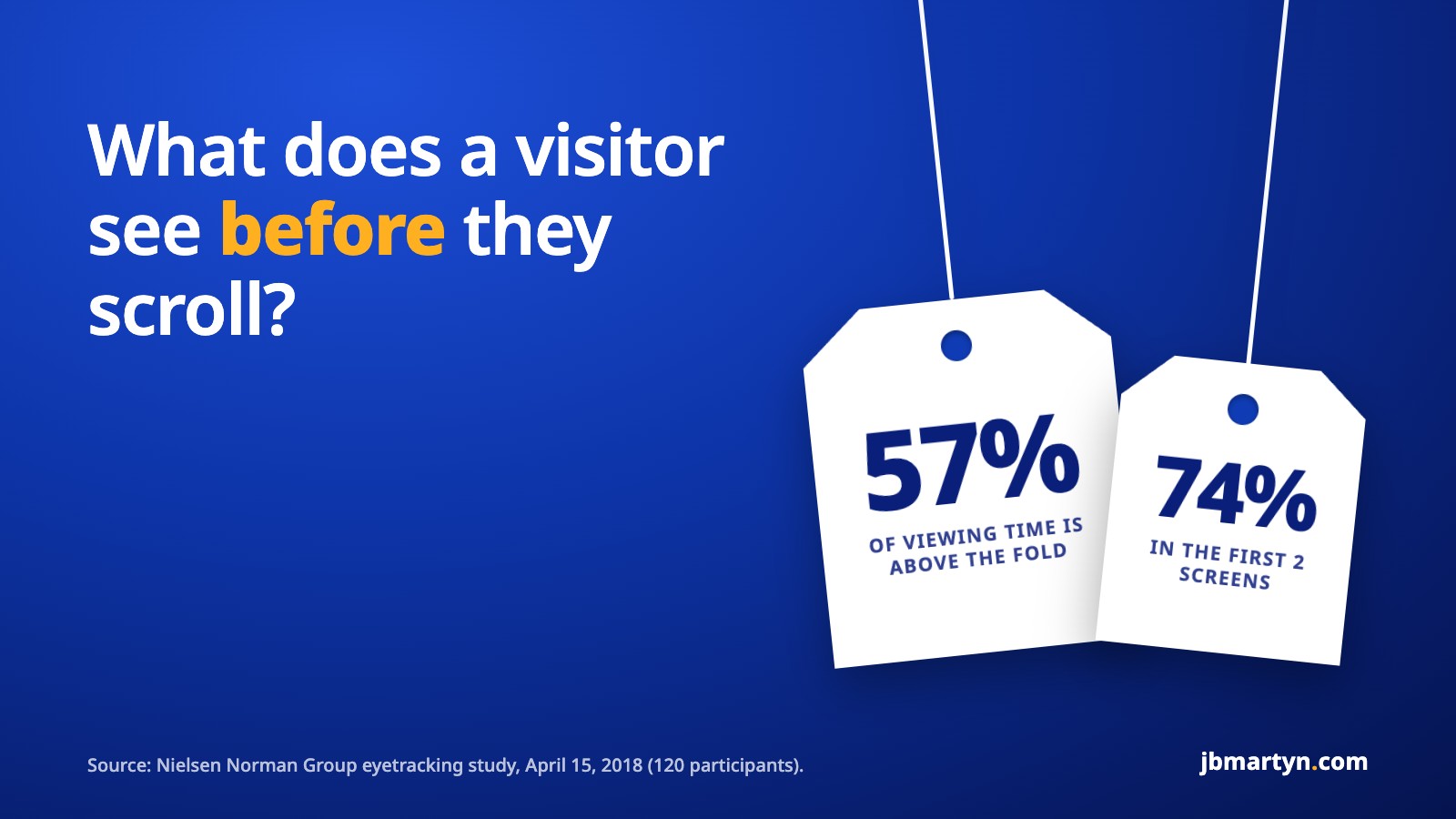
Where people look first. Custom graphic.
How Do You Test a Value Proposition Before You Publish It?
Run the 5 second test: show the line to 5 people who fit your buyer, hide it after 5 seconds, and ask what you sell and who it’s for. If 3 or more can’t say it, rewrite before you publish.
It costs nothing, and it’s faster than waiting for analytics.
Here’s what to do, in order:
- Say it out loud. If you stumble, the sentence is too long or too fancy. And if you’d never say it to a stranger, nobody wants to read it.
- Check the reading level. Unbounce’s 2024 Conversion Benchmark Report, across 57 million conversions and 41,000 landing pages, found pages written at a 5th to 7th grade level convert at 11.1%, against 5.3% for professional level writing.
- Replace every “solutions”. Say the actual thing you do.
- Run the 5 second test. Use real people, not your team (they know too much).
- Change 1 thing at a time. Rewrite everything at once and you won’t know what worked, and neither will your analytics.
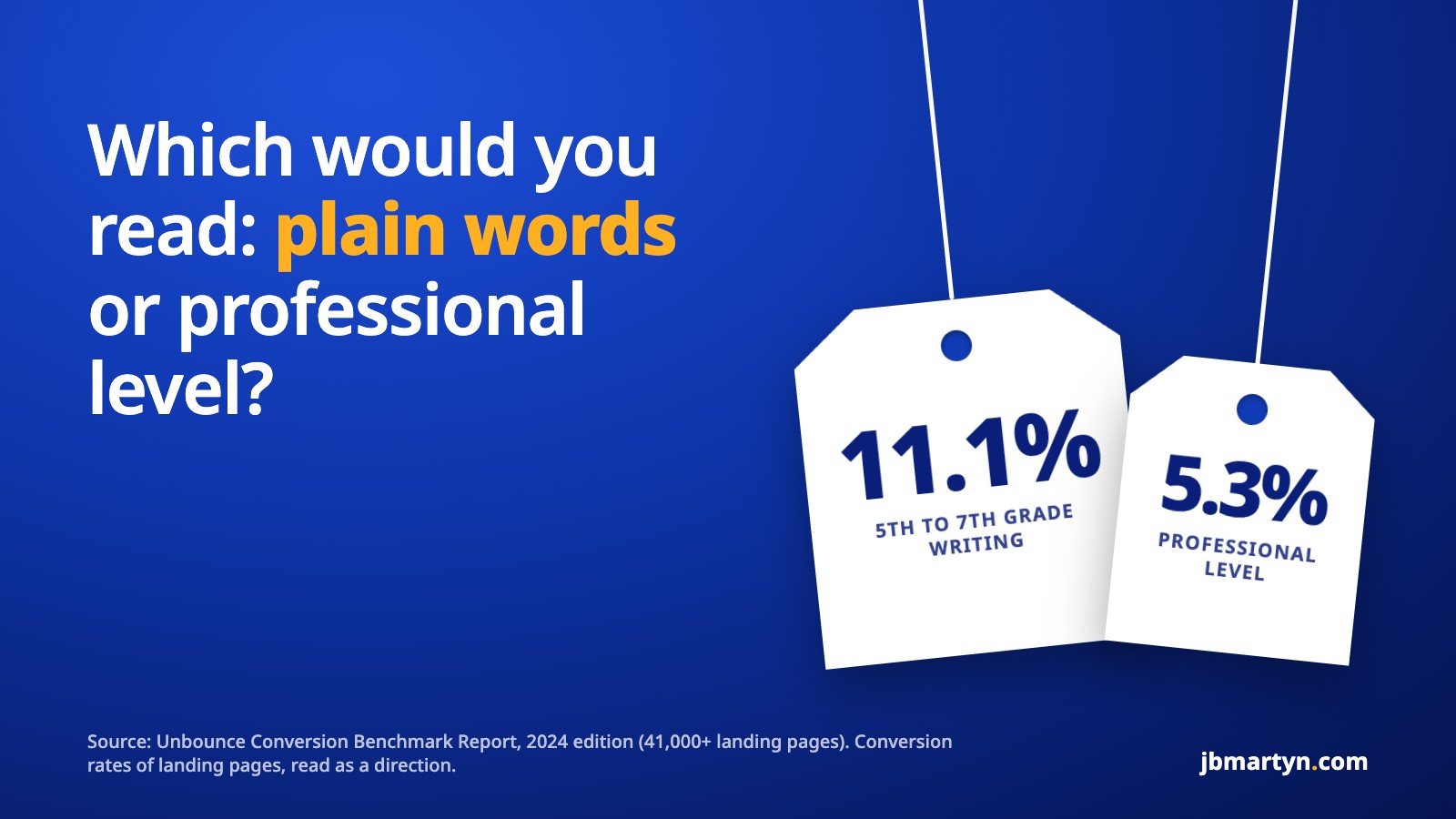
Plain writing roughly doubles the rate on landing pages. Custom graphic.

Test the sentence on 5 people before you publish it. Photo: Pexels.
Send me the sentence you have today and tell me who you wish would read it. Email me directly or fill out the form here, and we’ll work out whether it says what you mean, or whether it needs a rewrite from the ground up. That’s the kind of work I do at JB Martyn.
Real Questions About Writing a Value Proposition, Answered
What is a value proposition?
A value proposition is one sentence that tells a specific buyer what result they get and why they should choose you. Nielsen Norman Group’s analysis of 205,873 web pages says you have to communicate it within 10 seconds to hold attention longer, so it needs plain words and a named buyer, not a slogan.
How do you write a value proposition in one sentence?
Fill in 3 blanks: “I help [a specific person] [get a specific result] by [your way of doing it].” The short form is commonly credited to Steve Blank, and Geoffrey Moore’s 1991 positioning template is the longer version. Cut every word a competitor could say, then read it aloud.
What is the difference between a tagline and a value proposition?
A tagline is a memorable slogan of 3 to 7 words, while a value proposition is a full sentence that names the buyer, the result and your way of delivering it. The tagline helps people remember you. The value proposition helps them decide, and Wynter’s June 2026 survey found only 29% of buyers said any vendor’s messaging stood out.
What is the difference between a value proposition and a unique selling proposition?
A value proposition is your whole promise to a buyer, while a unique selling proposition is the one claim a competitor can’t make, such as “the only bookkeeper who sends a 1 page profit report by the 5th” (an invented example). Most small businesses need the value proposition first, then a USP once they have proof to back it.
How long should a value proposition be?
Keep it to 1 sentence, ideally under 20 words, in plain language. Unbounce’s 2024 benchmark found landing pages written at a 5th to 7th grade level convert at 11.1%, against 5.3% for professional level writing. Short words and a named buyer beat long words and a general audience, so cut anything a competitor could also say.
How often should a value proposition change?
I’d revisit it when your buyer, your offer or your proof changes, and at least once a year even if none of them has. If you’re getting the wrong kind of inquiry, the sentence is usually the first place I’d look. Change 1 thing at a time so you can tell which change made the difference.
Where should a value proposition go on a website?
Put it in the first screen of your homepage, as the headline or the line right under it. Nielsen Norman Group’s 2018 eyetracking study of 120 participants found 57% of viewing time lands above the fold and 74% in the first 2 screenfuls, so a line buried lower down is a line most people never read.
What are good value proposition examples for a small business?
A good example names a specific buyer and a specific result, like “I help ecommerce founders know their real profit each month, without learning accounting” (an invented example). The pattern beats generic lines because, per Wynter’s 2026 Sameness Benchmark, only 12.1% of the average B2B homepage’s messaging is something no competitor says. You can also see samples of how I write for more.