
Does Blogging Help SEO? What the 2026 Data Says About Blog Posts and Rankings

You’ve published a dozen posts. Your traffic hasn’t moved.
So does blogging help SEO, or did somebody sell you a story? It helps. But not the way most people do it, and the blog content writing advice you’ve read skips the ugly numbers.
Start with this one. Ahrefs’ study of about 14 billion pages found 96.55% of them get zero traffic from Google.
Now look at blogs themselves. Orbit Media’s 2026 survey of 1,042 marketers found only 14% say their blogs deliver strong results. That’s an all time low.
So blogging doesn’t fail because Google hates blogs. Most posts just skip the work that makes one rank. Let’s go through what the data says, and what to do about it.
Table of Contents
Does Blogging Help SEO?
Yes. Blogging helps SEO when each post answers a question people actually search, and answers it better than the pages already ranking. A post that does neither helps nothing.
Think of it this way. A service page can only target a few terms. A blog lets you add a new page for every question your buyers ask before they call you.
And every page gives Google something new to rank. It gives AI search something new to quote too.
But a blog is a way to show up for more searches. It’s not a ranking button.
| Blogging can | Blogging can’t | |
| Reach | Add a page for each question buyers search | Rank just because it exists |
| Authority | Build depth around your service | Replace backlinks on hard terms |
| Site structure | Give you pages to link between | Work if nobody searches the topic |
| Speed | Pay off over months | Pay off in a few weeks |
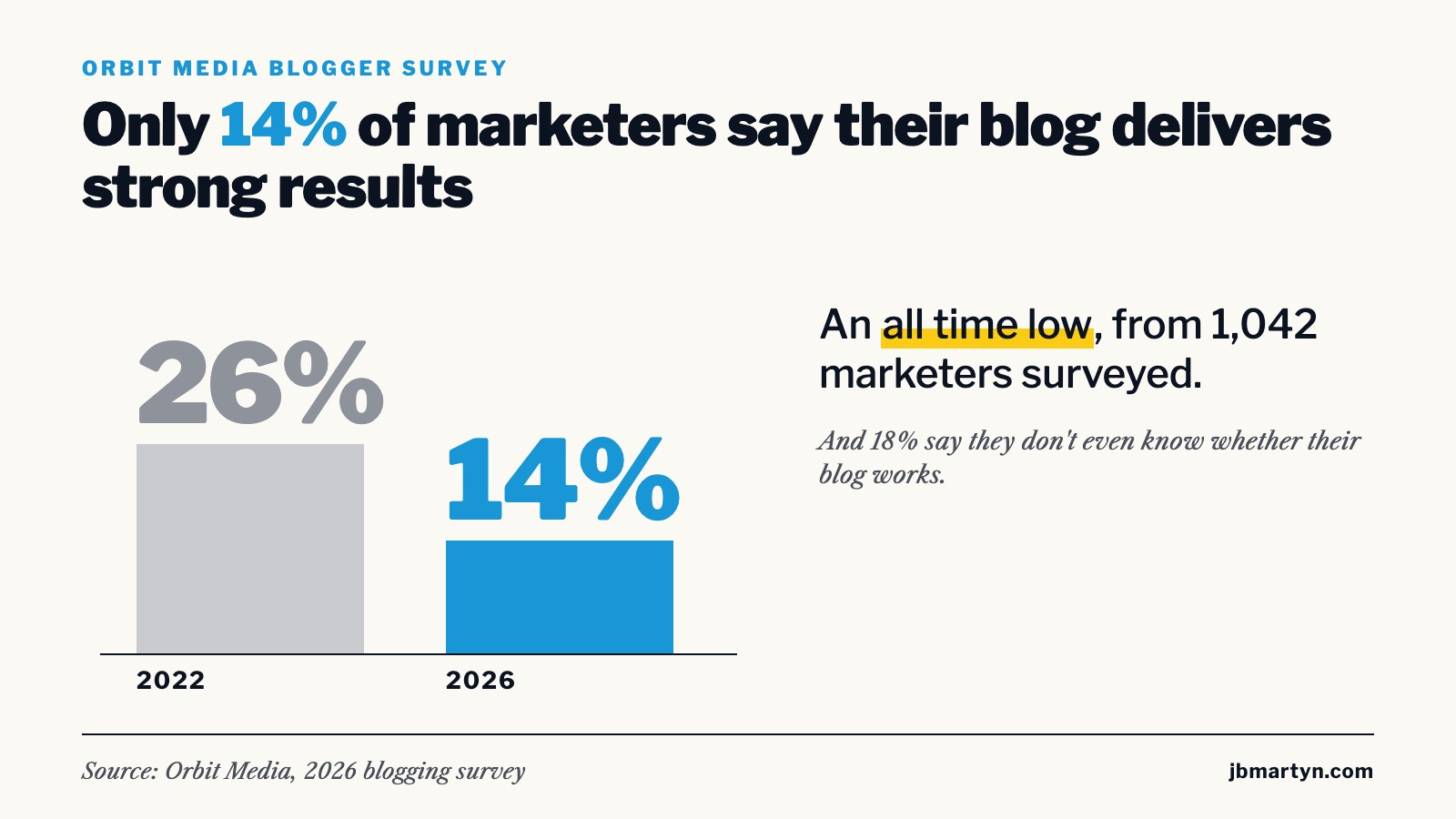
Orbit Media’s 2026 survey: strong results fell from 26% to 14%. Graphic by JB Martyn.
Why Do Most Blog Posts Get Zero Traffic?
Because most posts target a topic nobody searches, have no links pointing to them, or answer the wrong question. That’s the short version.
The long version comes from Ahrefs’ study, published December 1, 2023. Of about 14 billion pages, 96.55% got zero Google traffic. Another 1.94% got between 1 and 10 visits a month.
To be fair, that number covers every page in Ahrefs’ index, not just blogs. But it still shows the odds you’re up against.
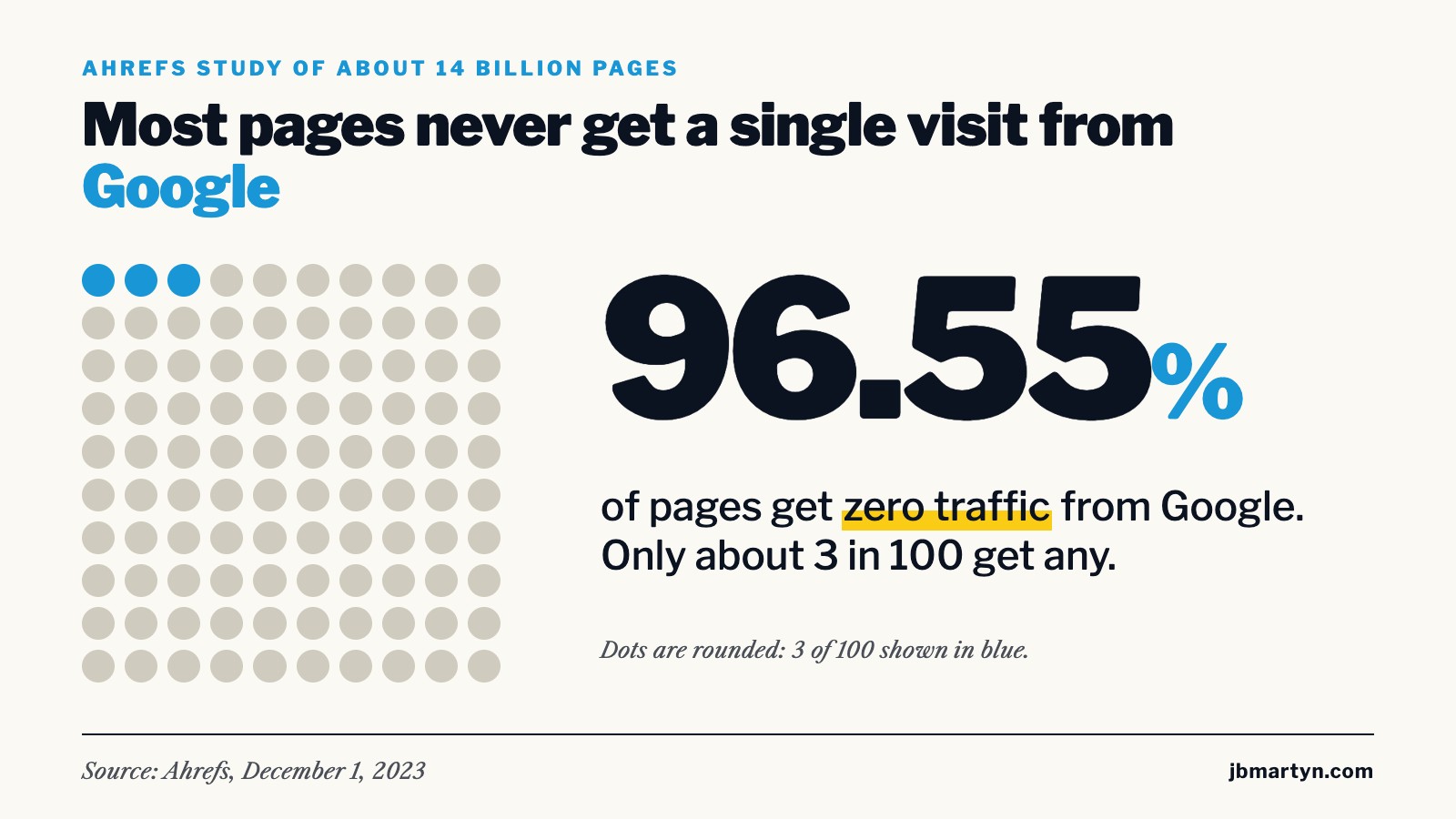
Ahrefs, December 1, 2023: about 14 billion pages studied. Graphic by JB Martyn.
The three reasons Ahrefs found
- No search demand. Nobody searches the topic, so even a #1 ranking brings almost no visitors.
- No backlinks. Pages with more referring domains tend to get more traffic.
- The wrong intent. A sales page won’t rank for a “best of” search, no matter how good it is.
That first one is the killer. And it’s the easiest to fix, because you can check demand before you write a single word.
Compare these two titles.
Before: “5 Reasons We Love Great Customer Service.”
After: “How Much Does a Website Redesign Cost?”
The first one is about you. The second is a question someone types at 9pm with a credit card nearby.

Check demand before you write a word. Photo: Pexels.
How Long Does a Blog Post Take to Rank?
Months, not weeks. For most posts, more than a year.
Ahrefs checked 1 million random new pages it found in September 2023. Only 1.74% reached the top 10 within a year. In 2017 it was 5.7%.
On a fairer sample of 2 million English pages, the figure was 6.11%. Even that means about 94 of every 100 new pages miss the top 10 in year one.
Age matters too. The average #1 page is 5 years old, up from 2 in 2017. And 72.9% of top 10 pages are more than 3 years old.
| Measure | Figure |
| New pages in the top 10 within a year (1M pages) | 1.74% |
| Same measure, 2M English pages | 6.11% |
| Same measure in 2017 | 5.7% |
| Average age of the #1 page | 5 years (2 in 2017) |
| Top 10 pages older than 3 years | 72.9% (59% in 2017) |
Source: Ahrefs, article dated May 15, 2025.
There’s one bright spot. Of the pages that did reach the top 10, 40.82% got there within a month. So fast wins exist. They’re just rare.

Blogging is slow math. Plan for a year before you judge a post. Photo: Pexels.
So blogging is a long game. If you need leads next month, don’t build your plan on it.
And while you wait, keep the posts connected. Link each new one to the older ones and to your service page, so a reader who lands on one can find the rest.
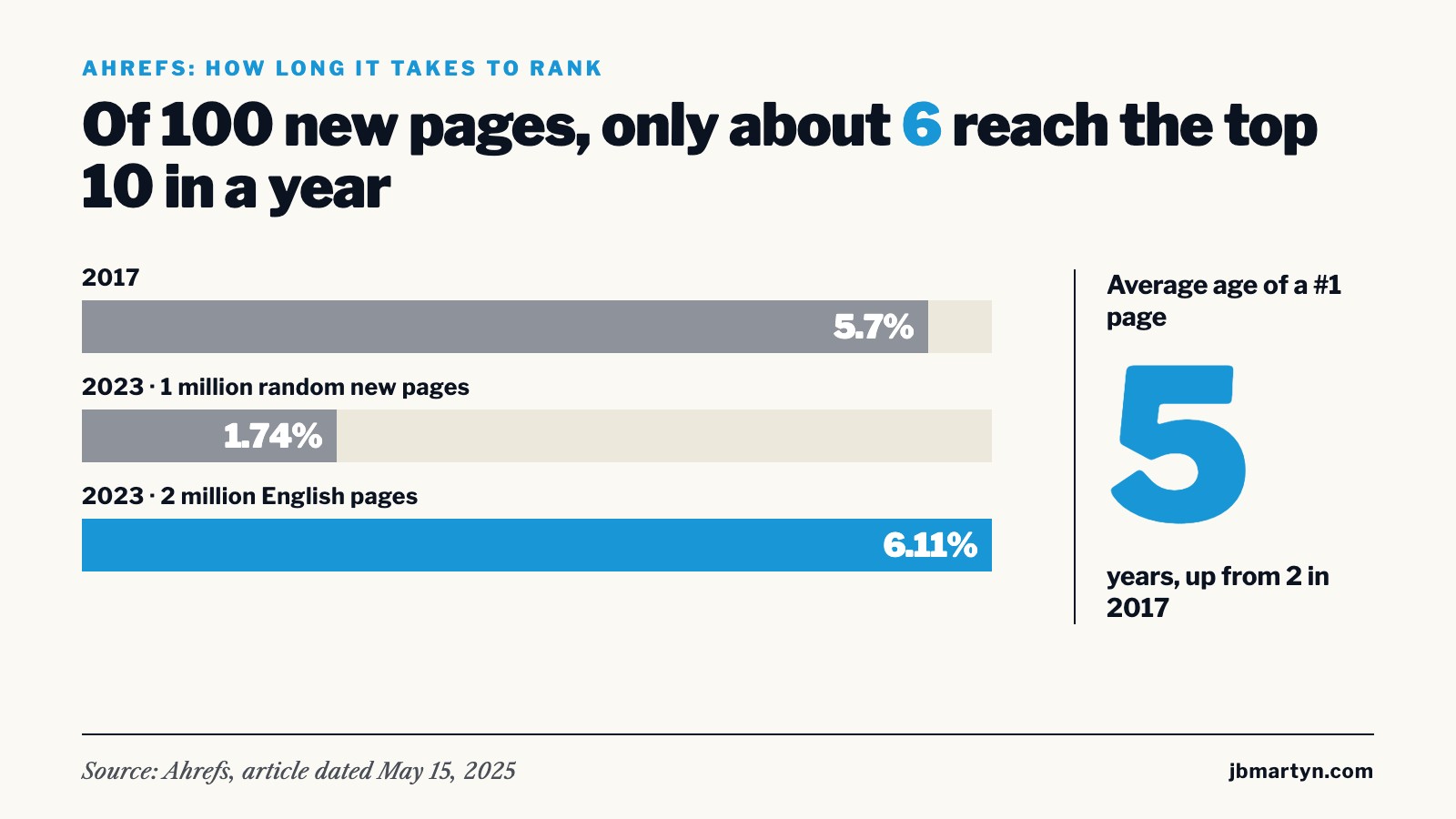
Ahrefs: 2 million English pages created in October 2023. Graphic by JB Martyn.
What Does a Blog Post Need to Rank?
It needs a searched question, a direct answer, something the other results lack, and links in and out. Most posts skip at least two of those.
Orbit Media’s 2026 data shows the pattern. Marketers using 0 or 1 of the 8 content strategies it tracks reported strong results 4% of the time. At 6 or more, it was 39%.
Orbit also says publishing original research improves the likelihood of strong results by 50%. So the winners aren’t just publishing. They’re doing more things, and one of them is saying something new.
How to optimize a blog post for SEO
Run through this blog SEO checklist before you hit publish. It’s my own, built from the data above.
| Step | What to do |
| 1. Pick a searched question | Check demand before writing |
| 2. Put the keyword in 4 places | Title, URL, H1 and first sentence |
| 3. Answer fast | Give the full answer in the first 2 sentences |
| 4. Add what’s missing | Your numbers, your example, your opinion |
| 5. Link to related pages | Send readers to 3 pages on your site |
| 6. Add a short FAQ | Real questions, answer first |
That’s SEO blog writing in six lines. If you’d rather have the technical side handled, SEO essentials covers it.
And no, you can’t stuff your way there. I covered why SEO content that reads like a robot wrote it loses.

The research happens before the typing. Photo: Pexels.
Do AI Written Blog Posts Rank?
Rarely at the top. Semrush’s April 1, 2026 study looked at 42,000 blog pages from the top 10 results for 20,000 keywords. Human written pages held position 1 about 80% of the time. Purely AI generated pages held it about 9%.
But don’t treat that as gospel. Semrush sorted the pages with GPTZero, a detector, and detectors get things wrong. So read it as a direction, not a decimal.
And look at this. Among SEO professionals who use AI content, 72% said it performs just as well or better than human written content. The rankings say otherwise.
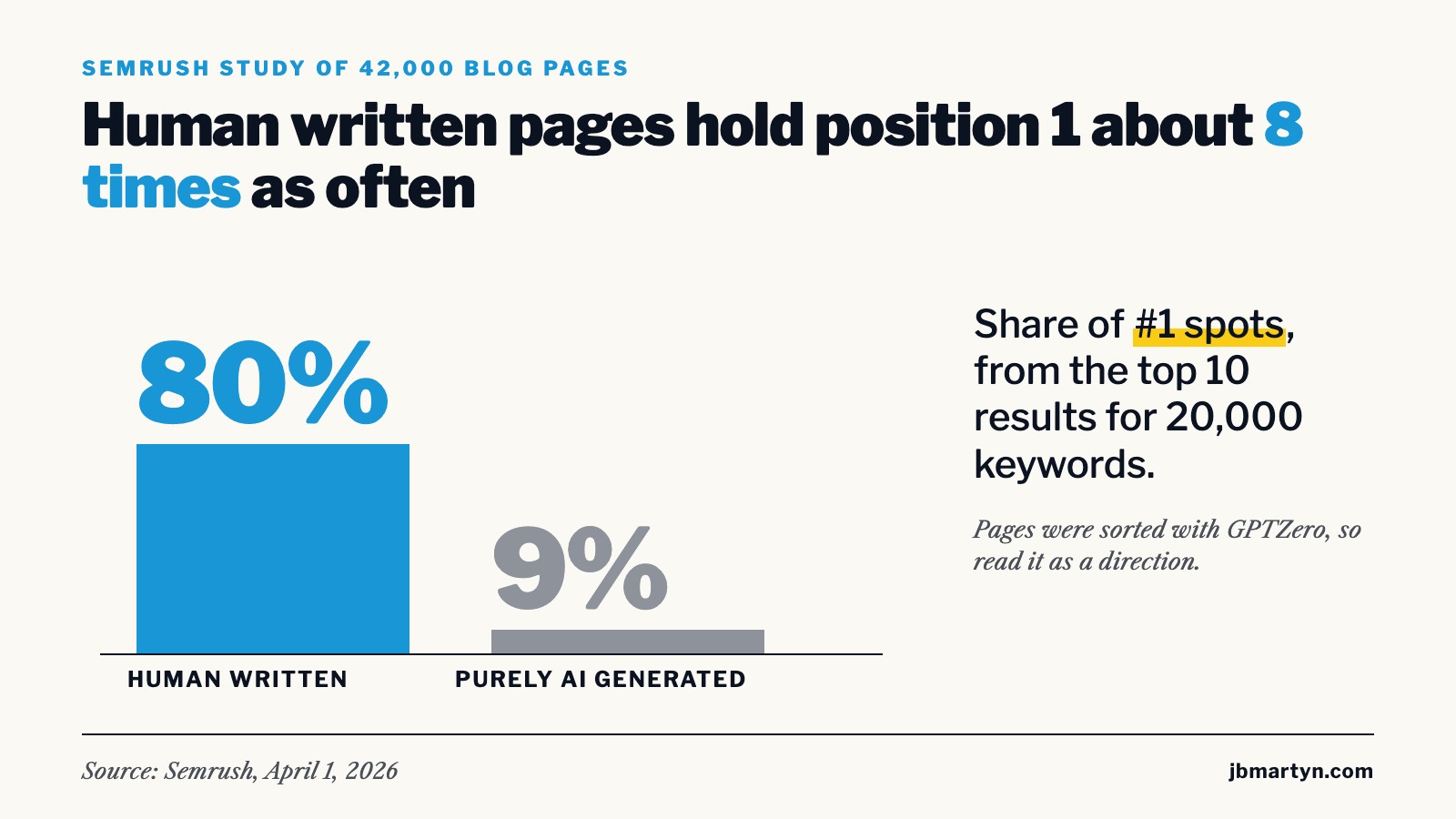
Semrush, April 1, 2026: 42,000 blog pages, sorted with GPTZero. Graphic by JB Martyn.
Meanwhile 92.4% of marketers in Orbit’s survey use AI. So everyone has the same fast first draft. What they don’t have is your experience.
Use AI for outlines and cleanup if you like. Then add the parts only you know: your numbers, your clients’ questions, the mistake you made once.

AI gets the first draft fast. It can’t supply your experience. Photo: Pexels.
Is Blogging Worth It for a Small Business?
It’s worth it if your buyers search before they buy and you can keep going for a year. If not, skip it for now and fix your service pages first.
| Your situation | Blog? | Why |
| Buyers search questions first | Yes | You get pages to rank for them |
| Nobody searches your topic | Not yet | Zero demand means zero traffic |
| You can’t publish for a year | Fix service pages first | Posts need time |
| You have your own numbers | Yes, publish them | Orbit: original research adds 50% |
A worked example: 4 posts a month
Orbit puts the average post at 3 hours 20 minutes. So four posts a month is about 13 hours 20 minutes of work.
What it costs if you hire it out
At the Editorial Freelancers Association’s 25¢ to 45¢ a word for blog posts, the average 1,312 word post runs about $328 to $590. Four of them is roughly $1,312 to $2,362 a month.
Those figures are my illustration from the EFA rates. Not a quote.
Is that a lot? Compare it to a year of posts that go to the 96.55%. The cost isn’t the writing. It’s writing the wrong thing.
If you’ve published a dozen posts and none brings a single visitor, you’re not alone. That’s the 96.55%, and it’s fixable. Use the form here or email johnm@jbmartyn.com and tell me the one search you wish a post ranked for, and I’ll tell you honestly whether a blog is the right way to chase it. I’m John at JB Martyn.
Real Questions About Blogging and SEO, Answered
Does blogging help SEO?
Yes, when each post answers a question people search and beats the pages already ranking. But Ahrefs found 96.55% of about 14 billion pages get zero Google traffic, so publishing alone isn’t the benefit. Targeting is. A blog that skips that step adds pages without adding visitors.
How long does it take for a blog post to rank on Google?
For most posts, more than a year. Ahrefs found only 6.11% of new English pages reached the top 10 within 12 months. Still, 40.82% of those that made it got there within a month. So judge a post at 12 months, not 12 days.
How many blog posts do I need for SEO?
There’s no magic number. Orbit Media’s 2026 survey found strategy depth mattered more: 39% of marketers using 6 or more of 8 content strategies reported strong results, against 4% of those using 0 or 1. Do more things well before you publish more posts.
How long should a blog post be for SEO?
Long enough to answer the question fully. Orbit Media’s 2026 survey puts the average post at 1,312 words, down from 1,427 in 2023. Don’t pad to hit a number. A post that answers the question in 900 words beats one that wanders to 2,000.
How often should a small business blog?
I’d take 1 well researched post a month over 4 rushed ones. Orbit puts the average post at 3 hours 20 minutes, and that time is where the research and the original numbers come from. Ahrefs’ 96.55% zero traffic figure tells you most pages go nowhere, so make each one worth finding.
Do AI written blog posts rank on Google?
Rarely at the top. Semrush’s April 1, 2026 study of 42,000 blog pages found human written content in position 1 about 80% of the time, against about 9% for purely AI generated pages. It used GPTZero to classify them, so treat it as a direction.
How do you optimize a blog post for SEO?
Put your keyword in the title, URL, H1 and first sentence, then answer the question in the first 2 sentences. Add 3 internal links, a short FAQ and one fact only you can supply. Orbit’s 2026 survey found publishing original research raised the odds of strong results by 50%.
What’s the biggest mistake people make blogging for SEO?
Writing before checking demand. Ahrefs lists no search demand as the first reason pages get zero traffic. If nobody searches the topic, even a #1 ranking brings almost no visitors. Check the keyword first, then write the post.